Sunday, December 6, 2015

"The Ivy League ---Just as dumb as everyone else" -- thoughts on the proposed post-season basketball tourney

I read a couple days ago that the Ivy League is on the verge of implementing an annual post-season basketball tournament

After 100 years or so, you think you know a conference...

Every Division I conference is granted single automatic bid for the conference champion to participate in the annual NCAA Men's basketball Tournament ("March Madness").

Conferences are allowed to designate the terms by which their champion is determined.  Originally, it was pretty sensible. A conference champion was the team with the best record in conference play.  In the event of a tie, tie breakers or some other means determined the champion.

The Ivy League has been smart and awarded their bid to their regular season champ.

The Ivy League system for breaking ties was exceptionally well designed --- the teams tied for the league would play each other in a single game ---winner takes the bid;  Both teams get a SOS bump.  The team that makes the tourney might end up one seed higher than they would have been ranked before the game; The loser would stand a better chance of getting into the CBI or the NIT or Bob's Fishmarket's Off-brand Post-season Tournament with a higher seed than they would have had without the game.

It made sense.  It was smart.  It was what you expect from smart people. 

Now it appears they are just as dumb as the rest of us.

It appears they will be using the new post-season tournament to determine which member of their conference will use the conference's automatic bid to the NCAA Tournament,  just like every other NCAA Division I basketball conferences.

Why is this dumb you may ask? 

 Let me tell you...

What you are giving up when you let a post-season tourney chose your champion

In college basketball, when you send your best regular season team,  you are usually sending a team that has lost 3 to 11 games out of 27-31 games.  So that team will have won roughly 59 to 90% of their games over the course of the season.  (Usually far closer to the 80-90% range...)

A team that wins more than the other teams in their conference is not necessarily more talented...although they can be... but they always are more skilled at winning.  

They have figured out how to go on runs at the right time.  They have figured out when a burst of hustle can create a turnover that destroy's an opponent's confidence.  They can smell blood in the water when a game is on the verge of turning.

Conference tournaments allow a twisted ankle or flu outbreak to flush a season of hard work down the toilet.  It invalidates all the hard work your student athletes put in learning to give consistent, smart, focused effort.  The very things college is supposed to encourage and develop are not rewarded by giving an automatic bid to the NCAA tournament to a team that sucked all season, only made the conference tournament because everyone was invited, and had 2-3 good games.

So it screws the students who have practiced the lesson of competing every day. It steals from them.

Those kids have earned that berth.  They have earned the right to compete against the best of the collegiate ranks. They have earned the right to potentially have a bad game on the biggest of stages, not have the right stolen to prop up a small-time tournament.

We wouldn't steal opportunities from are own kids, so why is this acceptable?

I would hope that thought would be enough to get school presidents and athletic directors rethinking that policy, but I am jaded enough to see that as smart as all of those people are, their attentions are on more compelling matters than sports minutia.  So they are given to groupthink and rely on conventional wisdom instead of actively thinking through peripheral sports matters such as these.

So let me give them a reason that touches closer to home.  Collegiate sports are just advertisements for a university.  A conference membership is losing money and  losing exposure when they allow their champion to be replaced by one of their dog teams.

It is one thing for a conference above the mid-major level to have a "winner take all" post-season tournament that reassigns their bid to one of their bad teams who got hot.  

There are 347 Division I teams.  There are 65 teams in the 5 football power conferences (The ACC, SEC, PAC-12, Big 12, and Big Ten).  Those 65 dominate college recruiting. 

The worst team in a power conference is more physically talented than most of the other 282 other schools at the DI level.  If that power 5 dog of a team finally figures out how to win, they will be dangerous in the NCAA tournament because they got hot and (for the NCAA Tournament) have really good talent.

I would argue even from the next conference ---Big East --- downwards, the worst teams in these non-power conferences do not have the talent to go on deep runs in the NCAA tournament.

Further, the NCAA Tournament selection committee seeds the teams a conference send to the tournament based largely on their resume.

Let me put the implications of this in perspective.

RPI =  a bunch of crap used to prop up the power conferences

RPI is a statistic used to compute the relative strength of teams and conferences vs. each other.  It is a very limited and frankly, stilted measure, but it is well-established as numbers the NCAA selection committee uses to evaluate teams for the tournament and widely accepted. 

Let's take a look at the last 5 years.

RPI 2012-16
Conference 2015-6 (so far) 2014-5 2013-4 2012-3 2011-2 Average
Big 12 1 1 1 5 3 2.2
Big East 2 2 4 3 2 2.6
Big Ten 6 4 2 2 1 3.0
ACC 4 3 5 4 6 4.4
PAC-12 3 5 3 6 10 5.4
Atlantic 10 5 7 6 7 7 6.4
SEC 9 6 7 8 4 6.8
MWC 9 11 10 1 5 7.2
AAC 7 8 8 7.7
MVC 15 12 11 9 8 11.0
WCC 17 9 9 10 11 11.2
CUSA 18 16 13 11 9 13.4
Horizon 14 15 14 12 14 13.8
MAC 13 10 12 18 17 14.0
CAA 10 18 15 24 15 16.4
Summit 12 20 17 19 16 16.8
Sun Belt 19 19 19 15 19 18.2
MAAC 23 21 16 14 18 18.4
Big West 11 13 22 21 26 18.6
Ivy 26 14 18 23 13 18.8
Patriot 26 17 20 17 22 20.4
WAC 28 30 21 13 12 20.8
Ohio Valley 20 24 24 16 21 21.0
Southern 16 23 30 27 23 23.8
Atlantic Sun 29 29 23 26 20 25.4
Northeast 32 25 26 20 24 25.4
Southland 22 27 27 25 28 25.8
Big Sky 27 26 25 28 25 26.2
America East 24 28 29 22 29 26.4
Big South 30 22 28 29 27 27.2
SWAC 21 32 32 31 31 29.4
MEAC 31 31 31 30 30 30.6

(data from realtimerpi.com)


Over that period the Ivy League's RPI average was very similar to that of the MAAC, Big West, and Sun Belt Conferences.  All three of those other conferences use a post-season tournament to assign their NCAA tournament bid, so they will allow us to look at this decision by the Ivy League clearly.

Evaluating basketball peer conferences to the Ivy League

Here are the per year conference champions and the conference's representatives for the NCAA tournament for the Ivy league and their basketball peers.

2014-15
Conference school rec reg. seas. tourney t. Record
Sun Belt Georgia State* 24-9 14 v. 3 1-1
MAAC Manhattan^ 19-13 16-13 16 v. 16 0-1
Iona* 26-8 24-7 - 0-1
Big West UC-Irvine^ 21-12 18-12 13 v. 4 0-1
UC-Davis* 25-6 24-5 0-1
Ivy Harvard* 22-7 21-7 13 v. 4 0-1
2013-14
Sun Belt UL^ 23-11 20-11 14 v.3 0-1
Georgia State* 24-7 25-8 0-1
MAAC Manhattan^ 25-7 22-7 13 v. 4 0-1
Iona* 22-10 20-9 0-1
Big West Cal Poly^ 13-19 10-19 16 v. 16 1-1
UC-Irvine* 23-11 22-10 0-1
Ivy Harvard* 26-4 12 v.5 1-1
2012-13
Sun Belt WKU^ 20-15 16-15 16 v. 1 0-1
MTSU* 28-5 27-4 11 v. 11 0-1
MAAC Iona^ 20-13 17-13 15 v. 2 0-1
Niagara* 19-13 18-12 0-1
Big West Pacific^ 22-12 19-12 15 v. 2 0-1
LB St.* 19-13 18-12 0-1
Ivy Harvard* 19-9 14 v. 3 1-1
2011-12
Sun Belt WKU^ 15-18 11-18 16-16 1-1
MTSU* 25-6 25-5 2-1
MAAC Loyola^ 24-8 21-8 15 v. 2 0-1
Iona* 25-7 24-6 14 v.14 0-1
Big West LB St.* 25-8 22-8 12 v.5 0-1
Ivy Harvard* 26-4 26-4 12 v. 5 0-1

So The Ivy League's champion has been seeded #12, #14, #12, and #12 in the last four years.  They have turned that into a 2-4 NCAA tourney record.

The other three conferences have had a team besides their regular season champion be given the conference bid 10 out of 12 times. 

10 out of 12 times their champion was displaced.  That should be jarring to you.

Based on that sample, the Ivy league can expect their best winners to lose their bid in the Ivy League post-season tournament roughly 82.5% of the time --- let's say 1 out of 5 years the champ will keep the bid.

And it gets worse.

Those replacements have been seeded #15, #16, #15, #15, #16, #16, #13, #14, #13, #16 and they combined for a record of 2-10 (the two wins came in the 16th seed vs. 16th seed play-in game...The NCAA tourney's equivalent of the overweight fan's halftime half-court shot attempt).

The two times their actual champions survived the post-season conference tourney without dead legs, colds, or fluke plays taking them down, they were seeded #12 and #14 and went 1-2. 

(It should be noted that two of their champions who were displaced had strong enough wins during the season to earn at-large bids, but the committee punished them by making them play a matching seed for a play-in game. Both schools lost in the play in round, so 0-2.)

Conceptually what you should get is it is very bad to be seeded 14th -16th.   We will cover this in a second.

Why NCAA tournament seedings matter

Here are the records of seeded teams in their round of 64 matchups over the last 19 years.

1996-2014
matchup record percentage
1 v.16  0-76 0.0%
2  v. 15 3-73 3.9%
3 v. 14 8-68 10.5%
4 v. 13 16-60 21.1%
5 v. 12 32-44 42.1%
6 v.11 27-49 35.5%
7 v.10 33-43 43.4%
8 v. 9 35-41 46.1%

It's a statistical bitch slap to be a 16th seed.  You get a participation ribbon.

A 15th seed is only slightly better. A 14th seed has about a 10% chance of survival. A 13th seed is double that.  Then a 9th to 12th seed are fairly good odds for an underdog.

Why is this?

Most media types who follow NCAA basketball are familiar with the basketball concept of  "The Seven Power Conferences" even if they call them something else.  Those are the 5 football power conferences plus the new Big East and the Atlantic 10.  Those conferences are considered elite because they regularly earn multiple berths into the NCAA tournament.

Usually the top 12 teams seeded as top 3 seeds in the 4 regions in the NCAA tournament are largely comprised of the top 2 teams in those 7 conferences---their champions and the team that they edged out for the title.  (Well there is a little more to it...You could probably subtract the SEC and Atlantic 10 runner ups and you maybe throw a Gonzaga in there. ...)

The point being that the top 12 teams are usually not only super talented, but also know how to win as a team.   The next 20 or so teams? (The 4th, 5t, 6th, and 7th seeds?)  Usually almost as talented, but with tragic flaws that make them very beatable.

"They have a dominant center...but they lost their starting point guard a month ago and their backup went down last week.  Will their 5'6" walkon freshman 3rd stringer be able to bring the ball up the court?"  That kind of thing...

Champions from the 25 conferences beneath the Power 7 tend to feature teams heavy with upperclassmen with one or two lesser stars who might get drafted by the NBA who make their teams dangerous.

Those kinds of champions are not usually going to beat the top dozen teams, but they are more than capable of knocking off a middling power conference squad in a 4th to 7th seed, because they are the sounder squad and the more experienced winners. (If you caught something there that sounds like I have a major problem with NCAA seeding philosophy...It's because I do. An article for another day.)

Here is a compressed view of the odds to make things clearer.


Seeding Records Odds of winning
14-16 11-228 4.8%
13 16-60 21.1%
8-12 127-177 41.8%

As I was saying earlier, the NCAA selection committee judges any school a conference gives an automatic bid to by that team's basketball resume for the year.

When you swap a proven conference champion from the lesser 25 for a crap team that only beat your best in the tournament because of an injury ....or due to the fatigue of playing 3 games in rapid fire succession ----something a champion usually isn't forced to do in the NCAA Tourney --- you turn your seeding from a likely 12-14 seeding to a 15th or 16th seed.  Your odds of seeing the next round drop from at high as 40% down to potentially 0%.

You move from the competitive seeding tier to the semi-competitive one or from the semi-competitive one to the participatory ribbon tier.

This not only costs the conference exposure, it directly costs the conference money.

The NCAA Tournament pays a team a tourney share for each game it participates in.  This means each time you win and earn the right to play another game, you get another share of the big pot of TV money.

Forbes estimates a share today is worth $1.65 million.  Shares add up, as this excellent article by the Washington Post explains.

Most of the lesser 25 conferences earn a share a year for their single team that makes the tournament and gets whacked. 

Using their current methodology, the Ivy League earned 6 shares in 4 years while their basketball peer-level conferences earned a 3-14 record, seventeen shares, which divided by 3 equals 5.4 shares.

OK, financially that doesn't look like a huge difference.   It's only $990,000 of direct tourney money the Ivy league would have potentially surrendered.

(Now it could have been $10.89 Million, if the Ivy league had been able to maximize their setup and get their second best team in and properly seeded as well by tweaking strength of schedule, but I get the fact that the Ivy League doesn't appear all too concerned about strength of schedule --- they likely weigh it appropriately vs. the hardship on their student athletes...)

The Ivy peer conferences also had the dumb luck to send the second worst team to the tourney two years out of our five year sample skewing the difference.  By propping up their stats with a totally underserved win in a play-in game vs. an even mangier dog, these conferences were gifted two shares (what divides down to another $660,000 per school) with their fancy participation ribbons.

 Let's be clear if I haven't been.  Those games are not really part of the tourney.  No viewer gives a crap about the "first four" in the tourney---especially the 16 vs. 16 matchup.  Most do not even watch them.

You have to think about the value added.

Which of the four conferences looked most competent over the last 4 years? 

Which conference's teams looked the most dangerous?

Which is most likely to have earned fans among the teens going to college today?

That is the value of the NCAA Tournament---promotion of your brand nationally.

Playing a conference tournament to decide who will represent you is like choosing to accept a "participation trophy" for the NCAA tournament each year. 

A lesser 25's dogs are not going to win anything.  They will never be the Cinderella of the tournament.

It wastes the open mindedness and goodwill of the viewers.  Sending your dogs just earns a conference the contempt of TV viewers.

Certainly you chose what exactly you want to value, but if the 2-3 best Ivy League schools chose to ramp up their OOC schedules with stronger teams from the bottom 5-10 conferences, there is a fairly good chance an Ivy without a post-season tournament might send two teams to the NCAA Tournament fairly regularly with both participating Ivy teams seeded in that #12/#13 sweet spot where they can do some damage.

Now I have been a little unfair to the Ivy League in that there are some valid reasons to consider a post-season tournament.  There really are.

My point is that it would be smart not to use it to determine who gets your automatic bid. 

Use it to showcase teams for the NIT and the other tournaments and to excite alumni, but don't fall into the trap of burning your chance to advance in the NCAA tournament. 

One tournament is out facing to the greater public and one faces in to people who already have a vest interest in the Ivy League.  Don't make the mistake everyone else makes and sacrifice the more important tournament to prop up your less important one.

All I am saying is...Just be smart about it.


Wednesday, December 2, 2015

With the conference powers at polar opposite ends and Baylor sneaking, is it time for OSU, TCU, and Tech to act?

I have covered the positions of the Universities of Texas and Oklahoma in the last two articles.  UT is against status quo-affecting expansion.  OU is not in as strong of a long-term position and wants supplemental recruiting help (making adding the University of Houston desirable) and a championship game.

Baylor is doing what they do and being sneaky.  They hope to get UH in to bind UT to the conference long term.

Baylor and OU leaders filling 2 of 3 slots on the Big 12 expansion committee (West Virginia has the third slot) created a warm environment for UH to drum up support.  UT allegedly forced the issue by pushing UH now as team #2 in an expansion effort capped at two members.  (How does this work?  "Will Kansas State who might have accepted Cincinnati and Memphis for Memphis recruiting vote for Cincinnati and Houston as the only likely expansion in the next 3-6+ years, knowing likely little recruiting help is on the way? Or will they vote down expansion until next time?")

Right now TCU and Tech are on the expansion sidelines.  

Tech appears to be thinking voting with UT is their best long term position.  It may or may not help them ---but it definitely doesn't hurt them.

TCU is likely looking at things and thinking they want a 12 member league for split divisions and a title game, but they don't want to get on UT's bad side and aren't too excited about Houston either.

Realistically OSU is probably out of the power conferences if OU leaves without them.  OSU wants to keep OU around while trying to be impartial.  They will likely vote with OU, though.

All of these schools could easily be screwed if OU and/or UT leave.

It might be a really smart time for this trio to acknowledge that working together in an effort to deliver a tolerable, impactful 2 team expansion is worth doing.

I am going to begin with the end strategy, but acknowledge there are a lot of steps that would need to be addressed first (---The first of which being going to the members of the expansion committee hat in hand and asking them to bless your efforts.  This strategy won't work if they get uppity about their time being wasted.  You have to be up-front. If the rumors of Cincinnati and Houston potentially nearing being presented for a likely unsuccessful vote are true, their work has been contorted a bit.  Plus Memphis losing their coach might change the positions of several voting schools.  Ask for a small window of time to build an alternative.  One week to find a pair that everyone will support, otherwise the conference votes on the committee's suggested pair --- as reportedly tweaked by UT.)

The end goal? In seven days, to get 8 firm votes to add BYU and SDSU.

BYU would get their sundays off, but would eliminate sports content from their network. SDSU would be in as long as they promised not to beat the conference membership to death with requests for more western members and they sink a lot of their TV share into reducing their obscene 28:1 student teacher ratio that diminishes the school's academic reputation.

If both schools are willing to comply, they are absolutely the best candidates for addition in the next few years.

Good enough?

Why them?  Two reasons.

1) They hit every need of the conference.  This conference need Kings. They are the only two potential Kings this conference can get today.  They add more then 10M people to the footprint and add more than 1 timezone, satisfying TV's alleged desires.  TV won't have any problem with this duo even though they are western. They allow a single flight west in each sport by 4-6 of the league's members.  Central and western divisions would ramp up the chances of UT or OU winning the central division each season (good for the league).  A zippered conference with 2 OOD rivalry games would allow all state rivalries to continue undisturbed and for the conference to maintain great strength of schedule vs. other power conferences.  (I've written it before ---given the Big 12's "school clustering" running up the central US, this conference would do very well to be zippered into divisions by the addition of a western division.) OU could play SDSU OOD for one "value" game helping OU with their supplemental recruiting issue. Heck UT could too.  This pair allows UT and OU to agree to forget about Houston for now.

2) SDSU didn't make the cut because no one in the Big 12 WANTS to travel out west*.   This mindset not only normally takes SDSU off the board, but also hobbles BYU's appeal and their chances as they are likely judged as either a football-only option (a single flight in one sport) or paired with a much weaker candidate in CSU that offers much shorter travel.  If you wanted to look at this strategy of bringing them back into the discussion, in coaching terms, there is "less film on SDSU".  If you want a group to accept a totally different conclusion than the one their handpicked committee arrived at, I think it has to have different names than those discussed ad nauseum.  SDSU's early elimination over travel "ickyness" gives this pairing fresh legs at this moment.

(*To me, a very shortsighted argument.  Adding this duo means 1 trip west a year in football and each Olympic sport for some Big 12 schools.  That's it.  And not even for all of the Big 12 schools!)

Who is traveling west?....Well...TCU, OSU, and Tech first and foremost.  Probably with  KSU.  You can't ask others to "sacrifice"  if you aren't willing to do so yourself.

The bottom line with this for our hopefully bold trio is if UT and OU take Kansas and bolt, there is no more impactful addition the conference could make than adding BYU and SDSU. 

If the big 3 leaves the Big 12, there is no guarantee whatsoever that BYU will see what remains as better than independent status.  It may be unlikely they chose to join what remains. 

Any version of the Big 12 that remains will be centrally based.   It won't consider SDSU without a good "bridge fanbase" like BYU.

So if this doesn't happen soon, if not now even, it probably doesn't happen.

If it doesn't get done, it is probably a bad future for one or all of  OSU, TCU, and Tech.

Fortune favors the bold.

Tech and TCU could approach UT with the idea. They make sense because they are UT allies and frankly if OU gets pissed about no expansion and beats the GOR,  leaving in a year or two, that puts UT in a bind.  UT's boosters will demand realignment movement to keep pace...and that could force a decision that leaves one or both of the UT Texan allies behind.

The case to make to UT is straight forward,  "UT boosters and leadership do not want Houston." (The rumors suggest both parties didn't like UH to start and feel kind of insulted/angered by UH in the recent past.)  "We get that."

"We have always supported UT's positions.  We feel the conference needs 12 starting this year.  We want BYU and SDSU to reach 12. We are here, hat in hand, asking for your support this.  Will you back our alternative proposal?"

I think that is a play UT would totally back. It is respectfully posed. UT has no horse in that race and as long as THEY do not have to play BYU in football, UT leadership may judge that it is an expansion that won't negatively change their plans at all.  In fact it may be see as a big positive.

If UT and Tech are in, along with OSU and TCU, you already are half way to admission.  You only need 8 total votes to pass it.  I don't think any Big 12 schools are going to vote against a pro-expansion UT's vote, but if you want to count the votes...

I think OU and West Virginia would be in as they are generally pro-expansion.  While it is no cupcake Big 12 North, a Central/West split would allow West Virginia to retain the better attended games they kind of enjoy while ridding their schedule of tough road trips like TCU and Tech. 

Baylor may be slow to surrender it's UH advocacy, but they are pro-expansion and the conference's long term odd are better with BYU in.

Kansas and Iowa State would probably OK anything that on the surface appears likely to extend the life of the Big 12 even if Baylor hold out.  There is your 8 votes.

Then it passes and everyone's happy.  Then down the road future realignment can be about discussions of adding lesser candidates in pursuing markets because the core issues will have been addressed.

=======================================================================

Post Scripts: I had a couple of things I wanted to add to this article.

What about BYU and Houston?

I have suggested in the fairly recent past that the best two team expansion the Big 12 could do would be BYU and Houston.  I said that because I don't think a two all-sports school expansion is a smart move for the Big 12 at all.  It doesn't begin to satisfy all the needs of this conference.  No two schools totally work.  4 to 6 is better given the conference's needs.

I think if you are dead set on getting two, one of the two has to be the only candidate who is undeniably a not only power conference member-level candidate, but a strong one at that. 

BYU. 


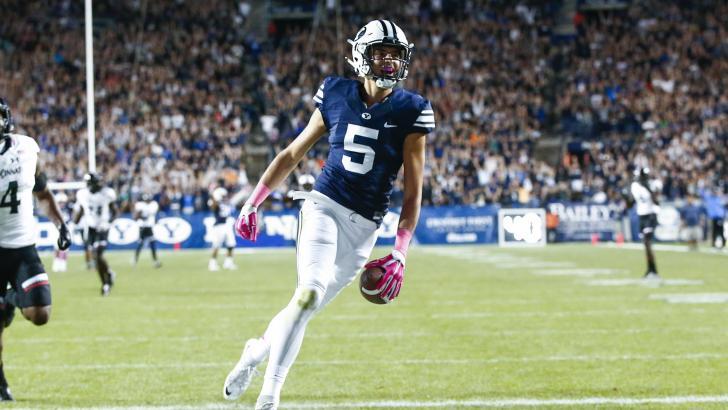
Here's a picture from the all-powerful Googler that pulls up under "BYU Dominates"...Who are they playing?  ...ahem...Cincinnati.


BYU is better than at least 50% of the current members in power conferences and their ceiling over the next 20 years may be top 5-10.

The very thought that the Big 12 would ever consider BYU as a football-only add to avoid travel makes me shudder.   Do they not see BYU makes the NCAA tournament every year and usually advances?  That alone is 2+ shares.


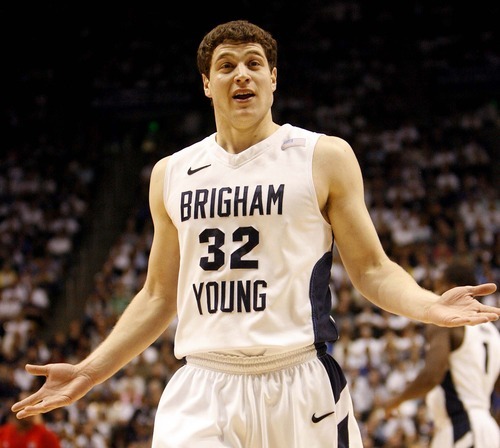
I know, Jimmer...Where is the love for BYU basketball??


As far as Houston in the other slot, my thought was that slot was earmarked for OU's needs to keep them in the conference.  It was mostly about who could give OU the supplemental recruiting they need to stay at a top 12 level.  Houston, Memphis, SDSU or one of the Florida giants could do it. But Houston offers OU it's traditional recruiting territory.  It is "easy". (Well, not to get voted in.)

I have said repeatedly I liked Phi Slamma Jamma and the Southwest Conference, but that isn't why I put them in the 12 slot.

The Big 12 leadership has stuck to realignment cw in the past.  Realignment cw says SDSU is far away and far away in a bad direction (the west).  That means they are "too far away".  (Get it? Get it? "two far away"? Eh...nevermind...)

It is a three hour flight from Austin to San Diego and a 5 1/2 hour journey from Austin to Morgantown, WV and a 4 1/4 hour trip to Cincinnati.  But San Diego is too far... because it is in the west.

(Not like Miami or Florida State.  They are close enough....)

If BYU was coming in, the Florida giants UCF and USF would be distance scratches. That made school #12 a two school race in my mind.

Houston and Memphis are close and I felt pretty sure Fuentes would be gone.

So why is SDSU potentially viable today?

DO I need to show you the helmet again?


Kidding.  (A little.)

I knew SDSU was tough sell due to travel.  I thought the Big 12 membership would discount them in a 4-6 team expansion and totally overlook them if they followed realignment cw and insisted on a two team expansion.

As I have thought about it though, I realize SDSU as a candidate may have some legs now that they did not two months ago.  Houston is somewhat a caustic choice for many schools (more so than even I thought) and that stirs the pot and may make schools take another look at things.  Memphis has likely lost much of it's luster as a candidate with Fuentes gone.

Frankly buyer's remorse may be sitting in a little on Cincinnati, the school alleged to be in the priority add slot as team 11--- Do you really want Cincinnati, the "Temple" of Ohio, over BYU, the "Notre Dame" of Mormons? Doesn't that sound like a bad decision?  They are a very "safe" add,  not a sexy one.

Cincinnati is a second tier Ohio brand. BYU is a first tier brand across the western US and due to their missionary efforts, all over the world.

This decision screams "Wrong thinking!"


One wonders what kind of advice the old Big East would have given the Big 12 as they passed on Joe Paterno's calls for a northeastern conference and let King Penn State float out there for years...

If you decide BYU needs to be the priority, not Cincinnati, why not pair BYU with San Diego State?

OU earns Big 12 a playoff spot. So... Any motivation for Big 12 expansion is now gone...Or is it??

The thought myself and others had was that if the Big 12's lack of a title game should keep them out of the playoffs again this year, Heads would explode and the moment of expansion would be upon us.

But OU had to be very, very good this year.

Thanks OU.

OU appears to have piled up such a lot of quality wins that even the lack of a championship game strength of schedule bump won't keep them out of the playoffs.  (I am of course knocking on wood with my lucky rabbit's foot as I write this.)

So a sated OU won't care to push expansion and the rest of the Big 12 can resume doing what UT wants.

Not so fast.

I think expansion may have gained steam.

Consider these points---

1) TCU was #3 at this same point last year  They killed Iowa State 55-3 and still fell to #6.  A big Ohio State win in the Big 10 championship game knocked TCU out. End result?  OSU wins the title (and not TCU?)

2) All of the Big 12 Conference's efforts to backload their schedules did nothing to help their teams this year --- only OU scheduling aggressively got them over the hump.

3) No team is ever more desirable than right after winning a national title.  OU has been unhappy about the lack of expansion for a while now and was rumored to have demanded expansion this year.  Now OU could totally lay an egg and be out in round one, but what if they win the title?.. (How dumb did the PAC-12 have to feel in passing on OU and OSU the week before Bedlam?  Would they sign off on an authorization of that move if OU ends the season #1?  Adding OU now is really the only way the PAC is likely to have a shot at UT on their terms.  Should OU get an offer could UT really convince them to stay? Is OU really ready to take on the GOR?)

4) Currently, a week before championship games, OU is #3 behind #1 Clemson and #2 Alabama and ahead of #4 Iowa, #5 Michigan State, and #6 Ohio State, and #7 Stanford.  Lets say Clemson and Alabama win.  Then Michigan State destroys what most fans believe to be a vastly overrated Iowa team.  This is the end of the season.  It isn't like in 2 weeks we will see Iowa ranked 20th after 2 losses.  This would be applied as a total destruction of #4 Iowa.  Could that and a bias towards the Big Ten jump OU?  Sure.  Now what if Stanford destroys #20 USC in the PAC title game?  I have to think they wouldn't pass OU, but what if we get some line like last year's where they are talking about a dead heat for the last sport, but they chose OU... If that happens do you think OU is going to feel sated with the conference's position with 10 members?

5) OU got lucky.  I have contended that  lack of depth is the difference between top 12 recruiting schools (OU is on the cusp of that) who usually play for the title and a 10-2 or 9-3 team on the outside looking in.  It's a few blown plays.  OU got beaten by UT --- a school with little depth and a freshman-heavy starting lineup.  That almost cost them their season.  What if OU had slightly better OL depth?  Does UT's DL dominate them?   Consider that if TCU's coach doesn't but conventional wisdom and go for a two point conversion earlier in the game --- they just kick the extra point --- the Frog's late TD ties the game.  They don't have to go for two then, an extra point kick drops OU to two losses and out of the playoffs. The Texas game should have been a little breathing room.   OU was totally dead in the water when Baker Mayfield went down.  OU should have a decent backup QB...Its all depth.   If you are going to consistently match up with Alabama, it is good to have.

OU has more leverage now. Will they use it?

UT's Big score: Why Longhorn leadership is likely against expansion of the Big 12.

I think UT would love to be in a conference with Notre Dame, North Carolina, and Duke....

Maybe that is the ACC....Maybe not.

Years ago, when everything was falling apart in the Big 12 over Deloss Dodd's Longhorn Network,  Chip Brown revealed that Dodds was pondering over some options no one had ever considered truly viable ---Independence or joining the ACC.

Dodds in particular seemed really jazzed by the ACC.  Longhorn fans vomited on themselves as the chill of thinking of a schedule filled with games with local rivals replaced by the distant alien brands (the Marylands, Syracuses, and Boston Colleges) of the ACC.

Video of Dodds talking about an UT/ND/ACC merger made it's way on to the internet. (although I thought I remembered him rattling off ACC schools...Perhaps a different cut? Still this video is a fun watch when Dodds starts talking about possibilities.  Check out the Co-AD's face...)

In my last article, I pulled rumors from some West Virginia tweeters that to my reading imply UT is not only publically against expansion, but that they may also be actively sabotaging expansion efforts --- Now rumors are rumors, but I don't find that really too hard to believe as I think UT sees the Big 12 as just a convenient apartment while it's future luxury home is built.

(Allegedly, last season the Big 12 was on the verge of expansion with Cinci and BYU when the Big 12 leaders heard that Arkansas and LSU might be interested.  The story goes that the rumor effectively killed expansion momentum.  Taking the story further, eventually OU came to believe that the existence of the LHN was the prime reason such a far-fetched sounding move did not occur.  This year UT allegedly insisted Houston ---apparently #5 on the leagues candidate list --- be the second and final candidate pushed for expansion.  If true, does Houston have the support to even be submitted for a vote?  If not, does that mean no one will be submitted for a vote this year?)

Now...It sounds like sabotage...If it happened...

What does UT have to gain?

Let's start by looking at the votes.

UT has their vote and they likely have Tech's vote against realignment.  (I am taking it that Tech realizes if they don't back UT, the Longhorns will kick them to the curb.  UT very well may anyway, but a compliant Tech with a reliable supporting vote might cause UT to bring Tech along if UT is forced west by OU joining the PAC-12.)

Allegedly Baylor was UH's advocate.  Baylor hoped to pull in UH and then use the combined political power of Baylor, Tech, TCU, and UH to bind UT forever to this conference.

As I have covered in great detail in previous articles, OU also appears to favor what adding UH would do to fix the TAMU sized hole in OU's Texas recruiting.

My guess is if there is any truth to all this UT might have anticipated this discussion dragging on to the point where the Big 12 added 4 schools and UH was bumped up by Baylor from #15 to #14.  That is a lot more palatable for the rank and file than UH up from #15 to #12 on a two team expansion --- eliminating a couple of schools that other schools may favor.

So why would UT resist expansion overall and expansion with Houston so much?

I think the obvious answer is that Houston and Baylor are not in UT's long term future plans and the Big 12 may not be either so UT will be damned if they will let in Houston, a school who could possibly help corral UT down the road.

A weaker Big 12 keeps OU and Kansas in play.  Those are useful schools for UT.

To understand why this matters you have to move to a different perspective.

A macroview of the power conferences

The Big 10 and the SEC rule the TV finances at the power conference level. 

The Big 10 is also an elite conference in terms of academics and research.  They have 5 of the top 20 research universities in the US and 12 of the top 50.  UT leaders would love an affiliation like that.  But they also love winning and getting great fan support.  UT's recruiting and fan support would likely take big hits in the Big 10 where despite averaging ~67,000 per game conference-wide, brands like Minnesota, Wisconsin, and Iowa, all of whom would likely be in UT's division, do nothing to excite UT fans and the cold and the distance does nothing to excite UT recruits.

The SEC has great recruiting territories and fantastic fan support (averaging ~78,000 in attendance) but with the exception of notables Vanderbilt ($478M - #35), TAMU ($666M - #19), and Florida ($636M -#22)  there is nothing all that great (from a power conference perspective) in the areas of academics and research.  Plus TAMU is already in the SEC.  UT will never follow little brother into the SEC and frankly TAMU might try to join South Carolina, Florida, and Georgia's coalition to block in state competition in order to block UT if they tried to join.

The PAC has financial issues with their athletics due to lesser fan support (averaging around 53,000)and tough geography that won't be cured without a big score in Texas or maybe some kind of Illinois and Missouri combination. They are much better academically than the SEC but only the top half of their conference rivals the Big Ten.  (4 of the research top 20, 6 of the top 30, and 7 of the top 50.) UT decades ago had a deep interest in the PAC, but all of that appears to have cooled substantially.  (I would argue that the inclusion of Utah, a school that would almost without question be pushed into a Texas division, was a mistake for the PAC in terms of landing UT.)  Oklahoma, likely UT's only truly valued conference mate, would likely look at the PAC as an optimal home.

The Big 12 makes solid money due to UT and OU, but is the worst academic conference in the power conferences and does little research.  Although they are great on the field, attendance outside of UT and OU is forgettable.  As a conference the Big 12 is averaging about 58,000.  UT's leadership knows that in terms of what they want ideally, they are "slumming it".  Still it is an acceptable home for the next 10 years.

The ACC rivals the PAC with similar small attendance numbers (~50,000 per game).  They are academically similar to the Big Ten with schools that rival that those in the Big Ten conference.  They have good markets, but presently only one of their two football kings is any good. (That is offset a bit as Clemson is a borderline king and is quite good these days.)

So in terms of research:

Conf.   Top 20 - Top 30 - Top 50
Big Ten       5          1          6
PAC-12       4          2          1
ACC            3          1          1
SEC             2          1         x
Big 12          x         1          x

The pecking order as most see it is:

1) The Big Ten
.
2) The SEC
.
.
3) The PAC
.
.
.
4A) ACC
4B) Big 12

OK...Nothing new there...But what happens if the best elements of the ACC and Big 12 are combined?

Katie, bar the door.

Let's say ESPN continues to talk out of both sides of it's mouth to the Big 12 and ACC due to their rumored strategy to try to push UT into the ACC as it now exists.  ESPN has some leverage on the ACC.  They always have.

The thought is that ESPN is in part dragging it's feet on the ACC Network to make the Big 12 membership indecisive about expansion.  With no expansion, there is a great chance that OU will eventually challenge the Big 12 GOR and that when they go, UT will look at the ACC.  ESPN will then basically drop the Big 12 as soon as their contracts allow and the Big 12 will become another American Athletic Conference.

ESPN is rumored to be playing both conferences and absolutely could be.

But what if UT is also playing ESPN?  What if UT's big hope is that ESPN pisses off the ACC elite with delays of the ACC Network to the point where the conference is on the verge of splintering.  Then UT says to Duke, FSU and UNC ---"Let's take the best of both conferences!"

Now what I am going to describe would amount to some real machevellian thinking by UT's leadership if done intentionally.   I don't see evidence of that.  I think the only intentional actions by UT's leadership are their efforts working against Big 12 expansion to keep as many long term options available.  I think UT's leadership sees the possibility of a worthwhile merger with the ACC, but that is it.

The thought out there (and a quite sensible on IMO) is that the only reason an ACC GOR exists today is because ESPN promised an immediate raise for their tier 1 & tier 2 content and an ACC Network for another raise shortly down the road.  (I am one who shares the view that there is no way FSU signed their rights over strictly for a $2-3 M bump per team on tier 1 & 2 revenue. A promise of an ACC network has to be the bait that had them bite.)

The thinking goes on that in ACC circles, without an ACCN the GOR is considered toothless (one of our West Virginia tweeters says  two people with ACC schools confirmed this view), but as every other power conference (besides the SEC who largely doesn't need one) has a GOR that they are counting on to keep them intact, no foreign network will attempt to poach the ACC, lest they inadvertently set precedence on how to disarm a GOR deal.

Lets play this out. If ESPN doesn't honor their ACCN commitment by say 2017-18 (a date that seems to keep cropping up as likely to be a 2010-ish realignment armaggedeon date) and the ACC elite decide the ACC GOR is toothless, how do the ACC elites escape the ACC TV deal?

Well, my first thought is that they pull a "Mountain West Conference" --- That is the best schools leave as a group to start their own conference.  "Not The ACC".

And what does that conference do?  It invites UT, OU, and Kansas to join them when the Big 12 GOR is up (or as soon as they can). Possibly with Notre Dame on a special deal.  Then they set about negotiating a TV deal.

Who would be in?  My thoughts would be "whoever UT wants in".  Why UT? Why not FSU or UNC?

Because at that point UT would be the "Kingmaking" King.  That is, wherever UT goes would move that conference up to the elite level in the power conference ranks.

And UT might be able to throw in the LHN as the conference network as their ante. The LHN can go long before the Big 12 GOR is up.  You think the LHN is a rotting carcass discouraging Big 12 survival today...

Wherever UT goes, OU and Kansas could and likely would follow.  UT would have a choice of the PAC with Utah and western travel or an ACC offering.  Whatever conference UT choses suddenly has an entirely different relationship with ESPN and the networks.  Do they chose the California powered PAC or the Florida, Georgia, NC, VA powered ACC group?

Dodd's actions in the last few years has had the Big 12 missing out on all of the available research powers.

UT is the only school in the Big 12 ranked  in the top 50 in research dollars (#30).  A move in either direction would correct that for UT.

Do you see why UT might just give the ACC elite a list of UT's preferred handpicked collection of ACC schools and the ACC elite might be OK with that?

So who are we talking about?

I am going to guess every school in the ACC that does mad research....

Or more specifically, The research triangle (UNC, Duke, and NC State),  Pitt, and Georgia Tech joining targets that bring extreme football value (Clemson, FSU, Va Tech, UVA, and Miami?)

So...
School  Research total (rank)
Duke $980 M (#4)
UNC $746 M (#14)
NC State $357 M (#53)
Pitt $806 M (#10)
Georgia Tech $611 M (#24)
Va Tech $393 M (#46)
UVA $271 M (#73)
Clemson $144 M (#116)
Florida State $208 M (#89)
Miami $278 M (#72)

state population total = 59 M

joining

UT $531 M (#30)
OU $105 M (#135)
Kansas $148 M (#110)

state population total = 33 M

total state populations = 92.4 M

Now that is an interesting collection of 13 schools in several  ways.  The only bad parts  are the geographically isolated nature of the central trio and having 10 in the east and the needed  number of top academic athletes in the east.

Now let me throw some other ideas at you.  Duke really likes the association with Wake Forest. Wake Forest is another elite academic school, but they are not a research power ($192-#96) and like Duke they draw poorly in football (27,210  in 2014).

Duke wants to know..."Is there any way we can bring along Wake Forest?"

What if the conference did a little horse trading with Duke?   Duke and Wake Forest are in as Olympic-only members.

Each receives a half media share and full voting privileges. They get a long term in-conference affiliation with UVA, UNC, and NC State.  They also get to play all 3 schools out of conference in football.  The duo agree to never pay football players a cost of attendance stipend and to play football in another conference.

Duke effectively gets WF in, sheds their FB problem, and gets a second vote!

(Now I fully realize I am getting into murky legal waters here, but both schools are private schools which means they largely can do what they want.  If I am framing the deal I start with the concept that the agreement is Wake Forest and Duke buying a 100 year in-conference affiliation with UNC and NC State for essentially agreeing not to compete with them for the rarest of creatures ---the 4-5 star blue chipper who can handle the academics at UNC and UVA---This is the reason why UNC has football scandals.)

I have to think CUSA and the AAC would love to add the duo as football-only members.  

From Duke and Wake Forest's standpoint, If they are being honest, it would solve the biggest problem with football.  In the CUSA/AAC-level most schools are using 2 and 3 star athletes.  It is a level where they can compete honestly. It is a ton easier to find 2-3 star football players who might just need occasional tutoring to handle the workload at Duke and Wake Forest.

Additionally, the cost of attendance stipend hits private schools very harshly. Wake Forest and all the ACC schools struggled with it.  This would pretty much erase most athletic problems at the four schools and give all the 4 North Carolina schools the ability to compete in all sports at a high level.

The Duke/Wake Forest deal would solve some problems for the conference.    Lets say the conference wants to add Notre Dame under some kind of deal like the current ACC deal --- most of the framework is there.  Notre Dame academically is very similar to Wake Forest and Duke.  They could join as Olympic members with a full vote but only a 1/3 share in return for being allowed to protect their national schedule and have the conference's backing.   They are allowed to only play say 3 games vs conference opponents.  UT gets a Chicagoland anchor.

Further implications --- Groundwork laid for an SEC raid?

Now at this point the athletic TV money is huge and is only being split into 13 1/3 shares.  They would rival or exceed the TV payouts of the Big 10 or ACC.  The recruiting would match or exceed the SEC.  The academics would certainly exceed the SEC's.

If you are Vanderbilt and you have a chance to "remain true to your southeastern identity" while joining a stacked research conference with academic stars in UNC, Duke, Wake Forest, and Notre Dame...You would jump, wouldn't you? 

Vandy is a basketball school.   How do you pass on Duke, UNC, Kansas, Wake Forest, Virginia, Texas....?

The SEC arrogantly believes they have no need to have a GOR deal because no one would ever leave a conference that draws so well.  Well, I think this is the scenario in which Vandy would leave.

What does that do to the SEC? Some would argue, "Nothing."  The SEC just brings back Tulane.

Maybe they are right.  Maybe not.

I think it would resonate at the next dominos...Florida and Texas A&M.

Maybe they'll fall....Maybe they won't.

Florida is a true King.

I admire UF a lot.  Florida is just like UT.   They are awesome at everything. Football, basketball... Undergraduate education?  Really good.  Research?  $592M annually; 15th best in the country.

Florida is an SEC blue blood but they are also a top notch academic and research university.  The loss of Vandy would bother them a lot, but that isn't what would have them thinking about moving.

Consider what happens to UF if this new conference puts Miami in the central division (Miami in it's heyday pulled a few blue chippers from DFW and Houston) with Georgia Tech and put Florida State in the eastern division with Clemson and the other traditional ACC schools?

That really gives a lot of power conference schools a chance at UF's native blue chip recruiting territory.  They already share with the rest of the SEC and a little with the southern ACC schools.   Are they ready for a more aggressive ACC push with UT and OU coming hard after blue chippers in Florida and Georgia?

Does tradition win vs. a "Big ACC" invite to Florida and rival Georgia?

Should those two football giants move, it effectively cuts off SEC recruiting at the Florida/Georgia borders --- effectively retaining the recruiting status quo at both SEC powers.  Rather than losing a chunk of the region to the SEC and the new conference, they just lose what they would normally lose to the SEC to the new conference.

With or without Georgia, I think Florida ---an SEC school that is actively blocking other Florida schools from joining the SEC --- would have to consider the offer for a surprising length of time.

TAMU has Aggie insecurities...

I think TAMU could happily tolerate the replacement of Vandy with a closer opponent in Tulane, but could they tolerate UT being in what would be perceived to be a far, far better conference?

....

An Aggie nightmare.

It would grate on them over time.

I think if Florida left, cutting off the SEC's Florida recruiting and removing the only other serious research university in the SEC, TAMU would sheepishly inquire about following and I think UT's leadership would quickly rubberstamp that.  (Only Dodds and A&M boosters wanted TAMU in the SEC.)

Other SEC & Big 12, etc. schools who might make sense.

A potential Florida departure would be a seismic impact. LSU would certainly consider pulling up stakes if Florida left.  They are in a mineable area for recruits for UT and OU. They would be welcomed by UT and OU.

Arkansas was UT's #2 rival.  UT would love to steal them back and such a conference would be hard for Arkansas's leaders to pass on, even if the rest of the SEC holds firm.

TCU would be an immensely sensible addition as they effectively protect the DFW recruiting territory that OU and UT rely on, but would it happen?

I think Texas Tech needs to hope for a UT/Tech PAC-12 invite or the Big 12 to survive.

Baylor could make sense in this kind of conference as in theory they should be able to recruit the SEC footprint for supplemental talent very effectively.  Hurting the SEC helps the conference. BU is quite good in football and basketball these days.

And football schools might not be the only schools considered...

With three Olympic-only members a fourth would seem to be desireable.  After seeing their football program shuttered on a whim by Alabama and Auburn, could UAB shut it down and join as the conference's fourth Olympic only member?  They are geographically well placed.  They do a ton of research and are often the state's best basketball program.  They are in a fairly large city...I like them as a possibility...but there are sexier brands out there.

How about Washington DC based Georgetown?  How would Georgetown look as Olympic member #4?  With Notre Dame in the conference, that is an acceptable conference move for a religious private.  They are a dynamite academic school and basketball brands do not get much better...

I think even if SEC blue blood solidarity stays in place, you could see a conference like this emerge.

"The Southern Powers Conference"

football divisions
Hurricane Division Mountaineer Expanse
Kansas WVU
Vandy Pitt
Arkansas Va Tech
Oklahoma UVA
TCU UNC
UT NC State
Georgia Tech Clemson
Miami FSU


basketball divisions
Domer Division Dukie Division
Notre Dame (Oly) Va Tech
Georgetown (Oly) UVA
WVU UNC
Pitt NC State
Vandy Duke (Oly)
Arkansas Wake Forest (Oly)
Kansas Clemson
Oklahoma Georgia Tech
TCU FSU
UT Miami


...Now admittedly the Olympic travel would be brutal for UT on those ND/ Georgetown trips, but the money and prestige would be amazing.

Notre Dame and UT putting together a 20 team association...Isn't that exactly what DeLoss Dodds described?

(Some may question some of the decisions I made in conference makeups.  In football, they were designed to ramp up ACC football attendance and drain the SEC talent reservoirs of Georgia and Florida as quickly as possible in a way that restores kings UT, OU, and Miami. In basketball they were arranged to feature ND and Duke.)

This is fleshing out for all to see the magical fantasy unicorn UT's leadership occasionally glimpses to the east from the corner of their eyes.

And wait...There's more...


There is no guarantee UT has to go east.

There may be another magical unicorn to the west!

I am not at all certain that UT's leaders' anti-PAC stance is at all sincere.  It may be all about laying the groundwork for a better offer.

If faced with the potential of losing any chance at UT or TAMU for good to an ACC merger, what might the PAC research elite do?  Would they sell out their conference mates?

I don't think a new PAC-14/16 --- the PACC-14/16? "The Western Powers Conference" is an impossibility.

A smaller conference membership gives everyone a bigger voice.

football divisions
Domer Division Sooner Territory
Notre Dame UT
Washington OU
Oregon Kansas
Cal Nebraska
Stanford Colorado
USC Arizona
UCLA ASU


Olympic divisions
PAC Division Central Division
Washington Notre Dame
Oregon Xavier (Oly)
Stanford St. Louis (Oly)
Cal Kansas
USC Nebraska
UCLA Colorado
Arizona OU
ASU UT

Final thoughts...

Now I am sure UT's leadership has much better things to do with their time than mapping out future longshot scenarios, but I bet they know UT's big score is what the ACC or the PAC is going to do to land them down the road --- not what the Big 12 does today to get to 12.

This is why I have said repeatedly, the Big 12 membership needs to think bigger.  The conference is at an artificially low point.  Smart moves can quickly recoup a lot of lost ground.  If they want to retain UT long term, they have to cobble together enough flawed, but valuable assets to move their position a lot closer to the above described scenarios. UT does like having a central conference...Make it easier for them to consider staying.

If they can't retain UT, they are in a much better position if possible kings San Diego State and BYU (along with other valuable assets) are already on board, than if they have to fight the AAC, MWC, and independent status for those assets when the current Big 12 TV deals are up.  That is a position that I think UT's leadership might legitimately understand.

Adding 1-2 meh schools for TV markets and then sitting for a few years doesn't fix the long term outlook for the Big 12.

In researching the tweeter article, I read posts repeatedly that UT's leadership seemed disinterested in what is going on.  And yet they have allegedly derailed expansion last year and may again this year. To my reading, they seem interested enough.

If UT seems unfocused or unmotivated, it is only because the future of "ACC vs. PAC for UT" is a ton more interesting and relevant to and for UT than whether or not UT's UH block maneuver will prevent the Big 12 from adding Cincinnati.

And that itself should be worth pondering.