Wednesday, September 2, 2015

An optimal plan for MAC expansion --- making better "offers that cannot be refused"

This is the last part on my two part series on the MAC and expansion today.

What is wrong with the MAC and how to solve it for good with expansion.

I would argue that the biggest issues with the MAC are not the same as in other conferences.  The MAC has secondary appeal in Illinois, Indiana, Michigan , and Ohio.  Almost 42 Million people live in those states alone.  That total doesn't even add in fans in Buffalo and western New York State.

That suggests that in the grand scheme of things, media markets may not need be the dominant driver for this conference as it is in other conferences.  That really gives the MAC a lot of freedom to address their needs.

The biggest problem with this conference is, with apologies to MAC fans and leadership, that the member schools are far too irrelevant. It is far too rare that any of it's teams are a threat to beat even a mediocre Big 12 or Big Ten team.  Despite having a full contingent of 85 scholarship players,  the talent level and depth is usually just not there on MAC teams. The rosters are just not talented enough.

While an addition of TV sets to the MAC footprint would be nice, the MAC really needs to improve their recruiting lot.

This could also be partially addressed if the MAC added a heavy hitter.  Or several.  They need a Boise State-level program and a Fresno State/Hawaii-level program (or several) to force members schools to meet a higher level of play, if not carry the conference banner outright ala the old football WAC.  Right now, the MAC has schools that act as pacesetters in a bad way,  dragging down the conference's level of play.

The second biggest problem is even if they successfully entice a quality candidate like James Madison to join, such a school will tear up the weak competition in the MAC, build a great looking resume, and get cherry picked from the MAC like Temple.

There has been talk of the Big 12 looking at 2 schools out of BYU, Cincinnati, Houston, or Memphis.  Should this occur, this will have ramifications that could affect the MAC. Cincinnati is generally considered the #2 school (whether you think BYU or Houston is #1) on the Big 12's list. What is the fallout if Cincinnati leaves?

Who does the American replace them with?  Do they try to retain Ohio relevance?  There are all kinds of schools out there, but The University of Ohio has turned itself into a program to consider, for a league that is good in football and wants to remain very good in basketball...  It is probably the third strongest academic program in the MAC and consistently competitive in both revenue sports.   Per game last year, they drew 20,515 in football and 6681 in basketball.   If the WAC remains at this status quo, there is a compelling argument for them to move on if opportunity presents itself.

Buffalo is another school that might get some consideration.  Buffalo averaged 20,403 in football last year and a decent 3639 in basketball and is the 2nd best academic school in the conference.  Their football isn't nearly as consistently solid as Ohio's, but they did go 23-10 in basketball last year.

There is a small chance that Buffalo and Ohio might get a look the next time CUSA or the American expand.  Is the MAC of today ready for life without either school?  Is the MAC ready today for life without the conference's most developed basketball program?

This reflects the core issue that lead to UMass saying, "no thanks."

Again the second big issue is that the conference itself is too weak to retain good members.  Any straight application of conventional expansion logic ('Get the best market available!' ) will fail in short order for this reason.


My Solution

Leverage the markets of the MAC into expansion into areas where other conferences won't go.  Continue to erode the perceived viability of the FCS. Take advantage of structural weaknesses in other conferences.  Target smart recruiting territory additions.  And above all else make schools offers that they really can't refuse.

I am going to lay out a detailed plan that mirrors what I see in the MAC behavior --- a desire to expand eastward with good academic public schools in good markets --- just like the Big 10.  The MAC seems to want to have 14-16 schools and I have worked with that goal in mind.

(It is a sensible goal.  Conferences play lip service to not wanting to get that large, but the reality is that if UT had accepted the PAC-10's offer in 2010,  the era of the superconference would be upon us, not creeping towards us.  The conference that moves first in that direction simply gets first pick.  The conference that moves last --- is immobilized by conference conventional wisdom --- becomes the next WAC.)

In some instances, I will talk about wading into relationships with 1-2 schools that may have a bit of chaos to their programs. I will do my best to explain my logic for that as I go.

The MAC has the ability to print a "golden ticket" for any I-AAA or FCS program in inviting them into the FBS.  This is an important concept to really get.

Almost every athletic program at all levels cannot generate enough money to cover it's expenses.  Universities and their students eat these costs at the I-AAA and FCS levels, but as the sports product is usually only seen locally by 4000 to 12,000 people at a football game or 500-2000 people at a basketball game, the return on investment these schools see in terms of advertising and alumni/booster generation is usually minimal. 

Low level FBS can be a real sweet spot in terms of getting a maximized bang for your buck out of both categories, at a still reasonable net cost.

Costs go up playing FBS ball, but having two big revenue generating athletic programs (FBS football and Division 1 basketball) can pay for most or even all of those costs if finances are managed properly and egos do not get in the way.  That's a much better situation than netting the same loss for a minimal gain in either advertising or booster generation.

That makes a MAC offer something that can totally and instantly rock the status quo in a targeted school's athletic program.  I ask you to think as you read the next sections on candidates, "How would the alumni and boosters at x university respond to a MAC invitation?"

I have tried to target situations where a MAC invitation can have a staggering affect in among the alumni and that can really make the decision simple for the school's leadership. 

In some instances, the MAC may be the conference where the majority of alumni already favor going next.  In some instances, I have targeted schools where saying no to a MAC invitation could lead a largely dissatisfied alumni base into simply opting out of supporting the program at any level.

This plan is put together to make it hard for a school's leadership at a targeted institution to say no.  I have tried to manufacture a series of very achievable, successful invites that play off each other and to finish with the MAC owning an idealized and stable "MAC of the future" that still has room to expand.

I ask your patience in not making snap judgements on the merits of individual targeted schools until the end of the article.  (Now feel free at any point to evaluate whether an invitation would dramatically cause a huge portion of a targeted school's alumni-base to demand MAC inclusion or not.  That is absolutely fine.)  Evaluate the end product MAC in terms of marketability, academics, athletics, and stability.

I am going to begin with some long needed house cleaning.

1)  Vote out Eastern Michigan on competitiveness and viability reasons.

In the early 1980's the MAC threatened to kick EMU out of the conference for poor attendance and non-competitiveness.  It's time to finally make good on that threat.

I am a fan of most schools with enrollments over 20,000 strongly considering playing FBS football.  I think at that size there are enough students to wash costs at inoffensive levels and there are few better things a university can do to turn alumni into large donors and to recruit out of state teens to find your school.

It is effective advertising at a reasonable cost.

EMU is one of the rare exceptions to the rule.

EMU is 7 miles from the University of Michigan.  They are in what I term a "media killzone".  That proximity destroys EMU's ability leverage their fans and the unaffiliated public to sell tickets, build fan and booster base from which to raise money.   Without fans in the seats, watching TV, and buying your merchandise, FBS is a money sink. 

This puts EMU in a bad recruiting spot.  FBS caliber players do not want to play home games in front of 4000 listless fans.

image source: http://www.stadiumjourney.com/

I have often thought that maybe if EMU did a demolition of the 1992 NCAA mandated (and, IMO, very poorly thought out) expansion work done on Rynearson Stadium, maybe EMU would have a shot to turn things around.  As major league soccer proved, stadium reductions make stadiums feel fuller and help build game attendance.  Removing the 1992 expansion would reducing their stadium capacity back to 22,000.  That is a healthy number for most MAC schools.

I have thought of a few coaches who could really turn things around out there.  The trouble is there are not many of them, and if they did turn it around, it would be too expensive to retain them.

This EMU situation is a chronic issue.  EMU has a .441 (441-564-47)  historical winning percentage today, 110th in the FBS.  There were only 18 FBS schools with worse "all-time" records, and 10 of those should not be on the list because are recent FBS upgrades who's sparkling records at lower levels were not counted!! (Among MAC schools only Kent state had a lower winning percentage all-time, but Kent State reduced their stadium capacity in 2002, draws 13-17,000+ per game each year, won 11 football games in 2012 and averages about 3000 in basketball.  Their program seems a lot healthier than EMU's. )

With not enough fans and not enough talent, EMU is bleeding money to lose in front of empty houses.  And they have been for 35 years.

And basketball is not much better.

Here are the last 15 years' numbers:

                                   football                   basketball

yearW-LAttW-LAtt
20142-1015,02521-13917
20131-11405121-14858
20122-10392316-181200
20116-6426714-181037
20102-1015,8859-221007
20090-12501617-15830
20083-918,9518-24915
20074-8744814-17836
20061-1114,73413-191531
20054-752197-212668
20044-7  no data12-182604
20033-9  no data13-152468
20023-9  no data14-141880
20012-913,2766-211659
20003-810,02715-132088

As grim as those numbers look, it's probably worst than that.

A lot of these football numbers look manufactured.  Given that the NCAA 15,000 attendance rule is about two year averages, the spikes in 2006, 2008, and 2010 look very suspect as does last year's spike.   Leading up to 2010, there was a lot of focus on the rule.  The realignment movement between 2010 and 2013 has made this less of a factor, but now we are in a period of somewhat calm, meaning more attention may be paid to the rule.

Using last year as an example, it is tough to believe that EMU drew 15,025 fans per game last year ---an 11,000 per game increase over the previous season --- to see a team with a season record only 1 win better.

I find it hard to buy that EMU drew 19,654 fans to see their 2-5 team, who had already suffered 4 blowouts in the first 7 weeks, play a 5-2 Northern Illinois team.  

Is the idea that Northern Illinois brought those fans?  Where were those travelling NIU fans the previous week when NIU beat Miami (Oxford) in front of 11,211 fans in Ohio?

You can call me skeptical.

I can totally buy that EMU had the ability to pull 10,000 fans in football in 2000.  I can also totally buy that they pull 3900-4100 for football games today.

Basketball attendance seems similarly disappointing, but at least the reported numbers seem consistent and logical.

A chunk of EMUs alumni have been dissatisfied with the school since the university retired the "Huron" name to satisfy political correctness.  The discussion of the merits of that action is not one I care to weigh in on, but the point is, because of this issue, EMU does not have access to all of it's potential booster and alumni wealth, making the financial problems even worse.

FBS football and DI sports are meant to draw fans, develop alumni into boosters, and promote a university brand.  EMU, as a MAC member, hits none of those goals. 

Continuing with this status quo is just wasting EMU's money.

This is like a crack habit.  It is unhealthy.  The MAC needs to stage an intervention for EMU's sake.

But the MAC member schools also need to do it for their own sakes.  EMU's membership is damaging to the reputation of the MAC.  Every time someone points at the 15,000 rule, they inevitably turn to the MAC and see all these schools who failed to meet it.   Those MAC schools laugh it off and say, "we will hit it next year" and then point to EMU and say "They never hit it."

That is, in a nutshell what is wrong with Today's MAC.  This attitude is what has them at the bottom of the FBS conference pecking order. 

Failure is ok.

No other conference's members think this way.

Removing EMU --- a program that legitimately may not be able to function at the FBS level --- would put the spotlight (and the heat) on the other schools that fail to hit the minimum from time to time, like Kent State, Ball State, Akron, Central Michigan, and Northern Illinois. 

The carrot and the switch works.  With EMU in conference, there is no switch. So EMU has to go if you want to change the culture in the conference.

Additionally, it happens that EMU is also one of the three lowest rated academic schools in the MAC and the only member categorized as a regional (ie. non-doctorate granting) university in the US News University rankings.  Additionally they are ranked very far down the list (77th)  in that category in their region ---basically a quarter of the country.

Most FBS schools are classified as National Universities.  EMU's ranking in the regional university list puts them in the same ballpark as some of the worst academic schools in the FBS ranks.  Their ranking is similar to Boise State's.

Removing EMU would also likely lead to a bit of a recruiting bump by the closest MAC schools --- Toledo, Bowling Green, Western Michigan, and Central Michigan.

It is unlikely EMU would receive an invitation from the MVC or the Ohio Valley Conference  if they dropped to the FCS level.  EMU is outside their footprint and represents an unwanted travel cost for an addition of marginal value.

Who would admit them at the FCS level?

They could probably join the Pioneer Football League.   It's members play non-scholarship FCS football.  That would be quite healthy for EMU's bottom line.  Members Dayton, Valparaiso, Butler, and Morehead State are all relatively close by and that group and fellow member Marist would likely swing a vote for EMU to allow sensible division travel costs.  EMU could compete at a high level in that conference.

In Olympic sports, the Summit League would likely take them as a 10th member, but the travel costs (really a smaller portion of a total athletic budget than many would have you believe) are relatively high in the Summit.  Still EMU might become a BB power in that conference.

That would be a cheaper way to stay in Division I, but there are other options too.

EMU might be well advised to drop to DII and join the regionally sensible GLIAC where they would likely do very well competing with Michigan schools like Grand Valley State, Wayne State, Michigan Tech, and others.

I take no joy in calling for EMU's dismissal, but at least whatever they decide to do after the MAC, it would yield a 1000x better advertising return on investment than what they are doing today.

The expansion map

Studying college football realignment for 30 years and writing about realignment for 15 has taught me among other things, that conferences are dysfunctional beyond belief.  Their member schools are selfish and myopically self-absorbed.  Conference members all seem to share the same conventional wisdom in their beliefs.

As such, there is always a fat turkey waiting to be harvested.  Case in point, the Missouri Valley Conference.

The MVC is a basketball conference comprised of private schools and public schools who know they have a good thing in basketball.

To protect this golden goose, the football playing publics have a football-only conference called the Missouri Valley Football Conference.  The MVFC was just another relatively strong FCS conference until they pulled in 3 football ringers in North Dakota State, South Dakota, and South Dakota State.

This occurred as most of the big draw FCS schools (Old Dominion, Appalachian State, Georgia Southern, etc.) moved up to the FBS world. 

North Dakota State has now captured an unheard of 4 FCS titles in a row (beating many FBS power conference schools along the way) and the MVFC has started to dominate the FCS playoff selections.

The thing is the Dakotas are in the Summit League ---a mediocre basketball conference --- one with big travel expenses for an I-AAA conference and little ability to generate revenue. 

And they are unlikely to ever get a reprieve as the Dakotas are tiny population states that bring little TV value to an Olympic-only sports conference.   The MVC won't add them as Olympic members.  The MVC privates won't vote for that.  There is zero benefit for the MVC to add even a single Dakota school as an Olympic member.

So...

2) Invite North Dakota State

Steal the crown jewel of the MVFC.


image source: http://news.sportslogos.net/


NDSU's admission could be tied to a promise by NDSU to complete their publically discussed stadium expansion plans by an agreed upon deadline.

image source: http://fargodome.com/

NDSU football sells out their games fairly regularly.  They were third in the FCS in attendance at 18,571 last year. They have talked about an expansion of the FargoDome to 25,000.  Fargodome General Manager Rob Sobolik has pushed back a little on the idea as the FargoDome has no other tenants who want 25,000 seats, but with an FBS invite on the line and a more modest expansion goal (say 22,000), I have to think the FargoDome leadership would rubber stamp that expansion.

No FBS conference is even considering NDSU due to North Dakota's tiny population.  The MAC can do it as they already have a good in-footprint population base.

NSDU fans and boosters are high on 4 straight FCS titles and believe in their hearts that NDSU should be in the FBS ranks. If a MAC offer comes, they will make sure it is accepted.

And because NDSU has no markets and no historic TV value,  no conference will even think about poaching NDSU for several years.  At that point NDSU will be firmly entrenched in the MAC, likely as their Boise State. 

Minnesota and Wisconsin recruiting in football and Chicago recruiting in basketball make the western division of the MAC an ideal long term home for NDSU.

NDSU cares about both revenue sports.  NDSU has 12 national titles (8 in Division II and 4 more in the FCS), a 681-370-35 (.643) all-time record,  an 18-1 FCS playoff record, 31 conference titles, a winning record against all but one MVC opponent,  and an 8-3 record against FBS opponents.  They have the culture of competing against the big boys that the MAC needs.

Last year NDSU's basketball teams went 12-4 in the Summit in conference and 23-10 overall.  They have healthy basketball attendances in the 2500-3000 range.

Taking the worst program at the FBS level off the books and replacing them with the best program at the FCS level would a message about what the WAC is trying to become.

I would publically let this sink in for a few weeks before taking the next step.  Let the media process it.

Be coy about further expansion.  Let schools who might have some interest in the MAC re-evaluate their position on a MAC invite.  Then on to step 3.

3) Add James Madison.


Image source: http://www.jmu.edu/


With NDSU  gone,  JMU, Delaware, and the Montanas may be the only programs capable of generating a profit at the FCS level.  Montana and Delaware have always been the school other FCS leaders point to in order to make their FCS viability arguments. 

JMU on the other hand is a school that just recently built over their track, added a large end zone berm, on the way to upgrading their stadium to 24,877 seats.  They look progressive. They look like a team that upgraded specifically to move up to FBS.  They do not look like FCS true believers. 


Bridgeforth Stadium  Image source: http://football.ballparks.com/
They might be very receptive to a MAC invite.  Especially after a  short period of wondering if the MAC membership was OK with staying at 12. 

Only two conferences would likely consider inviting JMU at this moment ---the MAC and the Sunbelt Conference.  The Sunbelt has been hot for JMU for a while, but it is likely the Sunbelt's academics are considered poison pill by JMU.

This MAC has a very good sales pitch for JMU.  Academically, the MAC is far superior to the Sunbelt.  The MAC offers a good travel and a good media exposure footprint for JMU.  With NDSU on board, the MAC would be seen as at least at a peer level in football to the Sunbelt in the next decade as the FCS upgrades reach 85 scholarships and find their feet.

(It should be noted that CUSA could offer JMU an invite, but given that their recent expansion methodology generally shies away from multiple schools in a state, it is unlikely.  A UMass or Ohio pairing with JMU or Georgia State could be a smart addition for that conference, but I think the conference leadership is likely eyeing the eventual admission of Georgia State --- as that program matures ---and Arkansas State for their 16 in order to have an Atlanta presence.  That would create tidy divisions --- a good spur in expansion votes.)

Plus upgrading to the FBS is expensive.  The MAC's eastern division can offer great travel cost savings.  Remember, the MAC has 6 schools in Ohio.  Ohio is just on the other side of West Virginia.  Western New York is just past Pennsylvania.  MAC travel would be cheap for JMU.

JMU would offer the MAC schools in Ohio some limited supplemental recruiting --- there is a lot of talent in Virginia.

JMU has a 271-206-4 record (.568) (9-10 in the playoffs) with one national title and four conference titles in their comparatively brief football history.  They averaged 19,816 per game last season.

JMU is a MAC-sized school (20,181) with a good mens' basketball program (567-432 averaging about 3400-3600+). At that attendance level, unlike UMass, JMU doesn't have to worry about MAC membership eroding the school's fan support.

JMU also excels in womens' basketball (779-447-5), and baseball (1092-670-8).


4) Add UW-Milwaukee on the condition that they add football.


image source: http://www.620wtmj.com/


"What?!?!? Wisconsin-Milwaukee starting up football?"

Yes.  This is by far the biggest limb I go out on, but IMO if you want to maximize the impact of an NDSU addition, adding UWM is necessary.  For this reason, I am going to cover this in great detail.

UWM leadership has been looking for a sport to put on campus to help build university pride in their students --- the stuff of future alumni/booster donations. For years now, UWM leadership has been looking into the possibility of football.

Now some will say, "Hey man, former UWM Ad Rick Costello was the guy pushing that.  His head was in the clouds. There is no basis in that."

Costello may have had some problems at UWM, but even critics will admit he executed some things quite well.  He was hired again fairly quickly and appears to be doing a good job raising funds and building facilities at his new school.

I think the critic's take is both inaccurate and unfairly dismissive of Costello ---  and most importantly, it misses the point.

For over a year, there was talk in the papers of UWM looking into the possibility of football.  If Costello's bosses were not looking into it, don't you think they would have told him to quit talking about it and to actively kill that chatter?

Why should the MAC invite them?

For Wisconsin media and recruiting relevance and for a consistently strong draw in football.  

NDSU is right on the Minnesota border.  As there are no Minnesota schools ready to make the jump, NDSU really works as a Minnesota-relevant school.  ...If there is a strong fan base in Wisconsin next door.

UWM has an enrollment of over 30,000.  That equates to a very large alumni-base which can impact conference TV viewership.

Add UWM and you get a huge alumni-base in the biggest media market in Wisconsin.  You get Wisconsin and likely it also gives you more viewers in Chicago and Minnesota.

Big Ten fans get the MAC and would be receptive to watch it sometimes.  The Big Ten footprint is friendly media territory for the MAC.

Minnesota, North Dakota, and Wisconsin would add about another 12 million to the footprint.

Plus UWM has historically dominated their conference in several sports.  The UWM athletic program has a good culture of success.

So why is/was UWM leadership considering football and why would they likely accept this invite? 

I'll give you 10 reasons 1) why they've thought about football, 2) why they would consider a MAC offer and 3) why they should take one if offered.

  • UWM needs an identity. Being a basketball school would be great, but there is already a 500 lb. gorilla in basketball in Milwaukee in Marquette University.  Add in the NBA's Bucks and there is precious little public dollars for basketball tickets left for UWM.  Add Hockey?  You have an established semi-pro team in Milwaukee already.  Not possible today. UWM does not have a lot of options. Thanks to the Packers pulling out of their occasional game in Milwaukee, there is no football of any sort in Milwaukee --- a city that really likes football.  Why not "UWM, Milwaukee's football school"?
  • UWM needs a sport students will attend that they can put on or near campus in order to turn students into future donors.  Moving basketball on campus cost UWM a portion of their existing Milwaukee fan base who were unwilling to make the drive to campus 14+ times a season.  A football home schedule is a very tolerable 5-7 home games.   Although the leadership loves the idea of moving basketball back to campus to support a nice new Convocation Center on campus and for it to be the sport that the university students go see, it is not a clear slam dunk that it is a great idea.  It is very risky to mess with your only functional revenue driver in athletics.  If you have football on or near campus, you can keep men's basketball downtown.
  • Which brings up another point. UWM is generating basically all of their incoming revenue for sports with a program that is the third best of it's kind in the city.  How smart is that long term?
  • Football excites the UWM boosters.  Just like at universities like UT-Arlington today or at Lamar of the recent past, there are a lot of older boosters who want to see a return of a shuttered football program.
  • The high school talent vs. FCS/FBS program ratio is great in Wisconsin and neighboring Minnesota.  Did you ever wonder why NDSU is so good? Why all four of the Dakota schools have been so good?  Why the Montanas are so good? Why Boise State is so good?  Why Northern Iowa has been so good?   Why Nebraksa was so good for so long? There is basically a lot of mid to lower end FBS talent in the northern states from Idaho to Wisconsin and almost no FBS programs to claim it.  In Minnesota and Wisconsin, the best 20 kids are spoken for each year, but the next 10 in each state are up for grabs.  The talent base is there waiting to fuel a successful UWM FBS football team. 
  • The net cost difference between MAC-level football and FCS level football can be negligible. The talk at UWM was and is of FCS football, but when you figure in attendance at each level (especially in big cities) and revenue generated offsetting expenses, the net difference between the actual running of an FCS program or an MAC-level FBS program can  fairly negligible---with one general exception...stadium construction costs... which I will discuss in a minute.
  • MAC Football is an exceedingly good financial proposition at UWM.  Milwaukee is a city of 600,000 in a metro area of 2 million. There are a lot of businesses in Milwaukee who would consider buying suites for UWM football.  UWM may actually be in a better position to sell suites than any of the current MAC schools.   UWM has 30,000 students and a huge alumni-base in Milwaukee.  It seems very similar to UTSA 15 years ago.  UTSA was a large enrollment, non-football school located in a big city.  They were a member of an FCS conference.  They looked around and realized FCS football struggles in big cities, so they planned to play FBS ball.  The situation in some ways is even more favorable at UWM, because the MAC schools all have attendance in the 13-22,000 range, so UWM would only need a stadium in the 20-22,000 seat range to satisfy the MAC membership. That is potentially a really cheap stadium and with the population, university enrollment, and alumni base in the city, if the stadium were placed within 1.5 miles of UWM, it should be easy to sell out. And the final exclamation point on this is that a capacity of 20,000 near the university lends itself to sensible traffic management that local residents could tolerate.
  • Because former AD Bud Haidet made everyone at UWM aware of the lay of the land.  The Milwaukee Wisconsin Journal Sentinel gave us a peak into the mindset at UWM when they quoted the man who was athletic director at UWM from 1988-2009."Without football, you have to rely on basketball and success there for ticket sales, fund raising, fan and student interest."
  • UWM's AD Amanda Braun is seen as a bean counter out of her league by UWM fans.  While I get the perception, no one is "just a bean counter".  Still this is what she has had to live with since a candidate the alumni wanted was passed over to hire her.  Politics makes for strange bedfellows and so do shared interests.  Regardless of sex, people who get into the AD business are very competitive and want to be respected.  What would earn the respect (and donations) of UWM boosters who want football more than her bringing in a MAC invitation?  Having seen her speak, I have little doubt in her heart of hearts that she is more of the mindset of running a program without football ---in fact I think that position, her meticulousness, and her dedication to practicality was likely the key reason she was hired by a beaten down University burnt out on dreamers--- but to earn respect from all UWM alumni (and the raise that comes with football), I would not be surprised if she became a strong advocate if an invite was made.  It isn't a bean counter move.  Plus it makes her other fundraising easier. "I need money for a football stadium! ...and new seats at the women's basketball arena."  "We need training facilities for football!...and a couple extra bleachers and a vending area at the soccer field".
  • Finally, the real final word. If the MAC makes a public offer to UWM and UWM turns it down, it would make life hell for the AD and the President because getting ANY money out of the alumni will be damned near impossible. Given the state of UWM athletics' finances that is a big hammer.

That is about the best offer that can't be refused I can craft.

"Ok....Fine...Where would they play?"

Obviously anyone's first thought is at the Milwaukee Buck's baseball stadium, Miller Park.  I am inclined to think the chances of playing a full season there range between slim and none.  Miller Park has a grass field that the Brewers would not like getting torn up.

Now a game a year there?  The season opener?  That would be exactly what is needed by UWM and may be very agreeable to the Brewers at a fair cost (half the gate?). 

First games are normally very strong draws because fans haven't seen the team yet and are starved for football.  Put the opening day game in a 41,900 seat baseball park with all the amenities one could want and you will have a nice draw with enough room for anyone who wants to come.  Have the MAC schedule either NDSU or Northern Illinois for the game ---two schools that will travel fans to Milwaukee.  Draw a capacity crowd to see the game...then play the rest of your schedule (vs. MAC teams that likely will not travel many fans) in a 20,000 seat UWM stadium  (think soccer specific stadium).

Use Miller Park to paint the picture of a larger total of game attending fans and perception of demand will help spur fans to fill UWM's 20,000 seat stadium.

A 20,000 seat stadium is still very expensive and where are they going to build it?

OK, first of all we need to take the mystery out of stadium deliberations to have an adult discussion on this matter.

"They do not have the money " is not really a valid argument. It isn't like universities who do build stadiums do it totally with cash on hand.  They all take out loans.

And it isn't like a loan can't be secured.  Public universities at this level do not have lousy credit.

The loans are probably always available.  It is getting the approval to secure the loan to build that is the issue.

Really all that has to occur is for university leadership (or state leadership) to rubber stamp a stadium is two things: 1) that a university captures a percentage of the building costs up front from boosters/alumni/fans that makes the university leadership comfortable that they can defend the construction and 2) that revenue, student fees, and alumni/booster/fan donations look very likely to pay off the loan payments on time.

(And sometimes university leaderships will OK a stadium construction loan even if those two things are not in place.)

If the plans have a modest cost, the odds of approval are quite high.

Stadium construction can be hideously expensive, but it doesn't have to be.  All stadiums are not created equal. And frankly, some stadiums are artificially expensive because of conventional wisdom gone bad. 

Plus colleges are guilty of playing the same stadium games as the pros in claiming hardship and then building lavishly.  Keep this in mind.  Just because a stadium one stadium at a certain capacity is expensive doesn't mean they all will be.

Colorado State is building an on-campus 41,000 seat stadium out of pure gold for $220 Million. (Ok it is not out of pure gold, but it you do have to keep in mind that the CSU plan is not just to build a stadium on campus, the plan is to build a high end --- but somewhat small --- stadium and rebuild a huge chunk of the campus around it with some supporting structures. 

Image source:  http://cdn1.theodysseyonline.com/
That is way beyond what I am suggesting UWM do.  I would advocate UWM building strictly a stadium, with existing structures filling in for the missing elements for now.

NDSU's FargoDome, an 18,700 seat in-door stadium, would be a nifty idea for UWM as a dome dramatically controls game day attendance attrition after snow storms and can be very much louder than an open air stadium, but building the FargoDome in 1992 cost the equivalent of $89 million today dollars.  While other older domes like the UNI-Dome and Kibbie Dome have much lower translated costs, it is unclear how much of that perceived discount is actually due to design advantages.  Recent  FCS domes suggest a ballpark in line with the higher price tags.  For example, UNDs Alerus Center would cost $107M in today's dollars.  For UWM... maybe next stadium.

Image source: http://grfx.cstv.com/

UNT's Apogee Stadium is the country's first LEED stadium, has a ton of bells and whistles, seats 31,000, and was built in 2009 for $78 Million.  It is a beautiful place.  UNT's Athletic department says if it hadn't been built during the hardest moments of the recession Apogee Stadium would have cost $140 Million. I do not know about the veracity of that statement, but having walked on the turf and looked at every inch of the stadium right after it was built weeks before it's first game, I can totally believe UNT got a lot for what it spent due to good timing.  Quality luxury suites, great turf, lots of cement construction, windmills, etc....The question of whether they really needed to spend $78 Million to build a 30,000 seat stadium....eh, lets leave that one alone...

Image source: http://greensource.construction.com/

Akron's more modestly priced but still VERY nice 30,000 seat stadium, InfoCision Stadium, was built the same year for $61 Million.

Image source: http://www.gozips.com/
The last two outdoor stadiums were built to stand for 30-40 years.  Seeking that can be suspect thinking.  It often doesn't address the fact that the needs of the school today will not match the needs of the school 20 years from now.

Throwing a one-size-fits-all stadium solution at a variable long term problem is often applying bad conventional wisdom.

No one likes sitting in stadiums that are more then say a third or so empty. You can build cheaper stadiums at the needed capacity that are still very nice and are designed to be expanded cheaply.
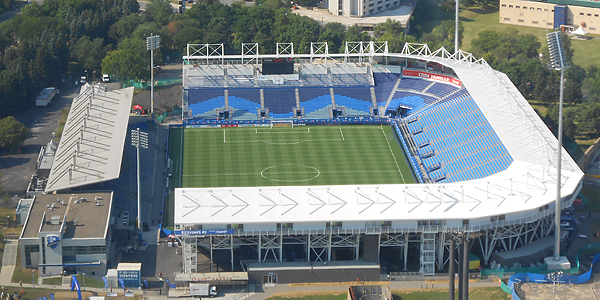


Image Source: http://media.philly.com/

Saputo Stadium is a 20,000 seat, 36 suite soccer-specific stadium built in 2008 right on a soccer practice field for a total cost of about $40 Million in today's dollars.  I think every seat is a fan friendly bucket seat and just under 7000 seats are covered.  Something like this would work wonderfully for UWM long term.

Or you could go even cheaper by using modular temporary building techniques or older bench-style stadium construction that use a lot less concrete.

Image source: http://lionbackers.com/
The Nussli Group built Empire Field,  a 27,528 seat temporary, modular stadium built in three months, on an empty field for $14.4 Million.  (It should be noted that the stadium only existed for one year and the low costs may very well have reflected a rental of the construction materials, not a purchase.) That stadium was nice enough for a pro football team to use for a full season. It had everything a "real" pro stadium has -- it just wasn't permanent. It featured 20,000 bucket seat and like Saputo offered some protection from the elements for fans.  (The Nussli Group has done a lot of time sensitive jobs that apply to football. One season they assembled a 6000 seat grandstand for the University of California in 36 hours and tore it down in 24 hours, over and over as needed, for the length of a season.)

Alfond Stadium's home grandstand.   Image source: http://football.ballparks.com/
Maine's Alfond Stadium is an example of cheaper traditional construction.  It has a home grandstand that sits about 8000 and a visitor grandstand that sits about 2000.  The stadium is very functional, but appears to be very bare bones with bleachers instead of bucket seats.  It reminds me of high schools stadiums in some regions, but it still gets the job done effectively.  Alfond Stadium was built in 1998 for the equivalent of $11 Million of today's dollars.  Even with material costs up, why could UWM not have the same home grandstand be built one side of a field and a similar capacity grandstand (without the press boxes and suites) be built on the other side of the field, yielding a 16,000 seat stadium for say $25 Million?  Throw in a pair of 2000 seat bleachers berms in the end zones and you have built a permanent 20,000 seat stadium with a 10 or 15 year lifespan --- or longer --- for maybe a $30 Million cost...

There is nothing at all that says you couldn't build something like that and slowly transition out to bucket seats down the road.

Really, I would argue the wave of the future in stadium construction is building an inexpensive facility that at least parts of it can cheaply be torn down and reworked in sections for future upgrades.

Look, I love Akron's stadium... but not necessarily for the Zips.  Imagine what a better position Akron would be in if their plan called for building a base of a 16,000 seat permanent stadium for say $40 Million and another $10 million on easily disassembled 14,000 seat modular upper level seating and end zone sections.  They would have much better control over ticket supply and demand --- the key to building a growing game day audience.  That is what they need today.

Build what you need today with flexibility for tomorrow.

Imagine a 20,000 seat UWM stadium with a 10 year planned lifespan where rows of seats could be added and removed as needed each week....Where every game would feel like a sell out!  You could have your default 20,000 seat stadium configuration for most games --- IMO your sweet spot in terms of not overrunning the local neighborhood streets with traffic ---  but when you have that end of season big matchup with NIU or NDSU for a bowl game berth, you can easily add 6000 seats.

--- All built for between $15 Million (full modular/temporary time frame) to $40 Million (1 permanent but somewhat inexpensively built home grandstand, a modular grandstand, and two modular berms).  On the higher end it could be a Saputo stadium-like permanent home that is suitable for 30+ years.

If you treat that as a cost on a 5-10 year home, with plans to replace it at that point with a nicer "base" when your boosters are fired up, your stadium costs could be as lower than $3 Million per year for the first 10 years. Home gate and luxury box revenue might pay that off fairly quickly each year.

(And that isn't looking at other revenue streams.  Look at MAC schools that pulled 20,000+ per game last season...UB reported they pulled in $6.7 Million in football revenue last season --- accounting looks suspect --- and Ohio reported they pulled in $8.4 Million --- accounting numbers look real.  You can look up similar programs at the Equity in Athletics website to get a feel for general athletic department finances, but keep in mind it appears very few athletic departments report both expenses and revenue honestly in appropriate fields or consistently from school to school.)

None of my math even looks at booster/alumni donations or merchandise sales.  Especially booster/alumni contributions.

The MAC could possibly have hesitations about this kind of cheaper stadium construction plan, but if you think about it, this is a great business model for MAC members that they can watch UWM refine on UWM's dime.

As far as locations go, UWM has several possible locations available to them.  Some are workable, some would be great but might not be possible, and some would be horrible mistakes.

I have a spot I would champion and a strategy to get it approved but it is a story for another article.  ...Or a consulting fee. UWM, I am happy to visit at any time.  :)

3) Add Stonybrook and Albany as Olympic members.


Image source: http://upload.wikimedia.org/
Image Source: http://stonybrookexaminer.com/


Why Olympics members and why them?

The standard payout for Olympic-only members in hybrid conferences is that they are paid 1/3 of a full media membership share.  In a cost vs. return argument, there is no question this duo is worth it.

Additionally, this allows the MAC to publically say, "We want you now for your Olympic sports, but when you both hit 15K in football attendance two years running, you will have the option of electing to join UB as full members."

That spells it out and would drive football attendance and fund raising at both universities.

This addition would give the MAC the three "University Centers" in the SUNY system that are located in good media areas. (The are only 4 UCs total in the system.)

The SUNY UCs are all very strong academic schools and would help the academic perception of the MAC.

Having Buffalo, Albany, and Stony Brook long term will allow the MAC to annex New York State as MAC territory, in exactly the same way they have Michigan and Ohio.  New York state has a population of 19.5 Million and only Syracuse and Army would play football outside the MAC.

Having these two in hand would improve the MAC's ability to recruit FCS schools in the NE.  That sounds off as these two SUNYs are currently passed over in a lesser regional conference, but you have to understand, in the MAC suffers in recriting schools in the NE because they have no members east of Buffalo.  It is very much the same problem the PAC-12 has trying to land UT.

Buffalo may push back on this using conference conventional wisdom, but that would be wrong thinking.  Buffalo in the MAC with these two ---even after they upgrade to FBS --- is a strong position for Buffalo.  Buffalo has the largest fan base and by far the best, most developed football program of the 3 SUNYs.  This would be like UT profiting off playing Texas A&M and Texas Tech in the Big 12. (That in itself is an article.  There are so many benefits....It would be great for Buffalo.)

Neither school is ready to play FBS level football, but at some point soon they could be (especially with a MAC football membership offer in hand to push fundraising).   They are however playing winning basketball and drawing MAC-level attendance in that sport.

Plus there is a lot of basketball talent in New York City.  If the MAC suddenly was accepted as being a NY state conference, those doors open up.

The final product

So we have looked at who is in and who is out.


Now lets evaluate the end product.


I think that is a very solid TV position and with 4 Olympic programs solidly in the NE and the other members of the eastern division in nearby Ohio,  it would ease a lot of the kinds of concerns that lead to UMass walking away.  (Now I am not saying UMass will decide to come back any time soon...I think they have their eye on an American invite.  I am just saying the next coveted school in the NE will look at a much more favorable MAC offering.)

It looks like a dramatically improved conference.  Let's look at football.  You would add two strong FCS programs.  NDSU may actually become the league's football pace setter in the west, dragging up the quality out there. N. Illinois should turn into a rival for the west division crown as they have a good football culture and should benefit from better recruiting via better exposure in the Chicago, Minnesota and Wisconsin areas. Wisconsin-Milwaukee should recruit well and be at least middle of the pack. Toledo, Central Michigan, and Western Michigan would all see gains in talent as they would effectively share in the redistribution of most of EMU's better recruits.

In the east, Buffalo and Ohio at minimum would likely see talent bumps through new recruiting territory in New York and Virginia.

In basketball, if each eastern MAC schools could add a good NYC recruit each year and western schools could recruit Chicago, Milwaukee, and Minnesota better, I have to think MAC basketball would improve on the court.

A Platform for a brighter future

Olympic membership for Albany and Stony Brook would have the MAC as a 14/16 conference. I have designed this to be the stopping point of my article as it is quickly achievable and leaves the MAC in a good position with a lot of flexibility.

That is a perfectly fine stopping point... but the MAC doesn't have to stop there.

With the "superconference" model there is a lot of flexibility.  Due to divisional play, a conference can go with double the members they would have in a single division conference and there is little real difference in terms of scheduling.

So 14 (7 teams per division), 16 (8), 18 (9), or 20 (10) are all good member totals.

What that means is that gives the MAC at least two more slots to easily play with if say a pair of flagship NE universities that add value decide they like the new MAC footprint. 

Potential members down the road...

This kind of MAC has the potential to consume the better parts of the Colonial Athletic Association (CAA).

Delaware in particular could become very interested in this kind of MAC overnight. Delaware is the 76th ranked national university. Delaware has a 22,000 seat stadium and draws big crowds.  Delaware's big thing about not moving up has been they do not want to enter the FBS spending race.  The MAC has never participated in that.   Among FBS conferences the MAC is unusually comfortable in it's own skin. Unlike all other FBS conferences, for Delaware, this new MAC could look like a good, stable long-term fit.

Delaware Stadium averaged 15,682 last season...down from the 20,000+ they normally get.
Image source: http://www.bluehens.com/
Full membership for Delaware and ....????

UMass could change their mind, but they would not be at the top of my list.

William & Mary would.   They are very small for an FBS school, but as MAC budgets are not ridiculous, the MAC would be a viable home. (Not that money matters here --- this is a very, very wealthy public with wealthy alumni.)  The prestige the College of William & Mary could bring  the MAC is immeasurable.  They are the second oldest institution of higher education in the US after Harvard and one of the original "public Ivy's".  They are ranked 33rd as a National University and would be by far the best school in the MAC (as they are in the CAA), but the conference additions above would make it a lot less glaring.   They would have seen the CAA gutted of all their old Virginia opponents and may want to consider coming along to the FBS.   They would be worth selling the MAC's soul to add, but they will either want in or they won't.  No soul required.  They are completing a $27M renovation that will add luxury boxes and increase the stadium's capacity to 15,400.

image source: http://football.ballparks.com/
New Hampshire?  UNH  is a live dog of a candidate should the MAC make an eastern expansion. Ranked 99th by the US News among National Universities, they would be near the top of the MAC in that regard.  They have an enrollment of 14,761.  They are a state flagship located in the Boston DMA.  They have long had a stadium bottleneck limiting attendance. That is being corrected with a new $25M,  11,000 seat stadium.   The new stadium looks very similar in concept to their old Crowell Stadium with a large home fan grandstand --- this one wraps around into the end zone though (a mistake IMO...see Rynearson Stadium's attendance history.) --- and next to nothing built on the other side of the field.  The good news is that makes for an inexpensive transition into a 18,000 seat MAC acceptable stadium down the road.

Image source: http://www.high-profile.com/
Rhode Island?  In the Bristol/Providence DMA (Would that help any with ESPN????).  Ranked 161 among National universities.  Lets call them middle of the pack in that regard as a MAC member.  An enrollment of 16,795. 22 years ago, URI's Meade stadium sat 10,000.  Today it seats 6580 and is similar to UNH's Crowell Stadium model with a home grandstand attached to the athletic building, except in this instance, the "home side" grandstand is small and the guest side bleacher is large. This looks like a more complicated expansion.  I would probably think to move the field 15 yards to the SSE (to the left) to create space for an end zone berm behind each end zone for students and discount tickets.  Both grandstands could then be lengthened to run from end zone to end zone.

image source: http://www.championshipsubdivision.com/
Maine?  It is in the Bangor DMA, has an 11,247 enrollment is ranked #173 among National Universities, but you cannot totally write them off.  When their old stadium was condemned, their fans got 10,000 seat Alfond Stadium up to snuff. That's a credit to their boosters.  Putting in an end zone berm and extending the guest grandstand into the north end zone might get capacity near 15,000, but likely a lot more work would be needed to get to an FBS capable stadium.

image source: http://www.stadiumsusa.com/
Or (here's a real outside of the box thought) give a call to Wayne Fredrick and ask if Howard University's president has ever considered taking the school into FBS football.  On the surface that is a "no" as there is  a perception of solidarity among the HBCUs, but I think that is a call worth making... Remember HBCU Florida A&M had a plan to jump to the FBS level about 15 years ago.  If any HBCU should be at the FBS level, shouldn't "The Harvard of the HBCUs"?  Big cities do not support FCS programs and this lack of support has been a long-standing problem at Howard.  DC fans certainly can support DC FBS programs at MAC attendance levels or higher.  RFK stadium is available and it is an infectiously fun home stadium where DC residents love watching games.

image source: http://c308991.r91.cf1.rackcdn.com/
Or the conference could consider football only invites at that point (although I would feverishly argue not to squander the progress made on this)...UMASS and Villanova ---football-only with extensive basketball scheduling agreements?

If football-only candidates were desired, I would be much more inclined to pursue Army and Navy as if the MAC should land them, they would be far more willing to mull over remaining long-term football members over competitiveness reasons --- although it is still a tough sell as a national schedule is far better for the academies' advertising goals than a relatively tight regional footprint.
(Perhaps alternating the academics between divisions each year could make it tolerable for the academies' advertising goals.)

If there are no good football takers, after a couple years the MAC would be well positioned to leverage their markets/TV money and to consider trolling the 4 major metro areas --- Boston, NYC, Washington DC, and Philadelphia for Olympic-only members (at this point, even looking at private universities).

Boston University or Northeastern, Fordham or NJ Tech, George Washington or George Mason, and Drexel?  None of those schools are really rocking in their current conferences (NJIT doesn't even have a conference!).  Being showcased in this kind of  MAC could be a game changer for any of them.

Friday, August 28, 2015

So they made UMass "an offer they couldn't refuse" ...and UMass refused....What should the MAC try next?

So the Mid-American Conference is again at 12 members. 

(To catch up those who do not follow the MAC,  more or less the jist of it is that the conference opportunistically offered Temple a membership, but only a football-only home ----probably in part because MAC schools weren't thrilled with the idea of travel costs to Philadelphia in their Olympic sports and because they knew Temple was likely only a short-time member.  The conference followed that up by inviting UMass to move up to the FBS level as a football-only member to balance divisions and hopefully open the door to future expansion in the northeast.  When Temple's boat finally came in and the Owls were invited into the Big East (now the American), it opened up a clause where the MAC could offer the Minutemen a "join as a full member or get the hell out" offer.   At this point, unfortunately years after the MAC's Temple decision,  the MAC membership appears to have realized they are leaving money on the table by not upgrading the conference's basketball.  It suddenly became very appealing to add UMass basketball.    It sounds like the MAC waited until the last month and then employed the clause --- basically trying to make it too difficult for UMass to say no. UMass figuratively flipped them the bird and walked away.  It may have been less contentious than that, but more or less, that is the story.)

So now covered in the egg yoke of a school with a 2-22 record at the FBS level telling the MAC effectively that the conference sucks too much to join as a full member, the MAC has retreated to it's den to lick it's wounds. Anyone who has felt the sting of unrequited affection can relate.

So what should the MAC's next step be?

The MAC needs to take action now, while it can be argued that they are in the driver's seat.

With honestly no disrespect meant, I think the MAC should have a brief, but intense period of self-reflection, followed by a smart plan to address the conference's correctable failings that also acknowledges the conference's rather pronounced limitations in generating realignment leverage.

What does the MAC have to reflect on?

Well, who they are and who they want to be as a conference.

The bottom tier of the FBS used to be populated by 3 relatively equal conferences --- the MAC, The Western Athletic Conference, and the Sun Belt conference.

Arguably the WAC (with Boise State and Hawaii) was the best of the three and the Sunbelt --- a conference that had to dip into the FCS ranks to survive -- was the worst.

The MAC had one thing over both conference --- a stable core of teams.

But times have changed.  The WAC imploded when the member schools couldn't stop applying conference conventional wisdom and take action with a long term perspective.

The Sunbelt profited from the realignment madness, upgrading it's front office and losing several mediocre teams in CUSA's pursuit of markets and replacing them with two members of FCS royalty ---Appalachian State and Georgia Southern.  No school in MAC has fan support that rivals those schools'.

In a very real sense the MAC can now be seen as the worst conference in the FBS ranks, with many, if not most of it's schools having difficulty keeping football attendance over the long-standing official (but never enforced) biannual attendance threshold average for FBS membership of 15,000 per game.

It is telling that CUSA did not poach ANY member of the MAC in this go-around.

MAC members aren't mediocre.  The fact is, they are marginal.

No members of the Missouri Valley Conference are actively pursuing MAC membership.  There is a reason for this. MVFC football has better talent, despite having 20 fewer scholarships.

MVC basketball is dramatically better.  Why increase spending to join the MAC, when there are no benefits to be had?

Again. It is damning.

A sales point of the MAC is that they are a conference of peers and as such any school can suddenly run the table.  The trouble with that is that a good coach comes in, runs the table in the MAC against a bunch of teams with mostly upper-level FCS talent, gets beaten in a bowl game, and then the coach leaves for a real FBS job.

It is a conference with 3-5 mediocre teams and a bunch of dogs every year.

So what is the solution?

Well,  there are a couple of basic directions the conference can take depending upon how the self evaluation goes.

1) A drop as a conference to the FCS level. (Very unlikely, but potentially not a bad idea.)

No one really knows how much the expense levels at the FBS level will be in the future. The power conferences are going to set rules for themselves, but there is a good chance they will also impose some rules on the non-power conference schools too.

Maybe this is a good time for the MAC to bail on the FBS ranks.

Unlike other conferences dropping, there would be no real loss of stature for the MAC in such a move.  With the exodus of top teams from the FCS level in recent years, an FCS MAC would instantly rival the MVC in football as one of the best at the FCS level.  Frankly, that can be seen as an improvement in status.  As an FCS conference, the status quo in their Olympic sports would remain the same. 

Now at least a couple MAC schools would likely never even consider such a move. IMO, the outliers especially.  Buffalo for one has worked too hard to get into the FBS.  I think Northern Illinois as well as they hit me as a "football school" and as such FBS status matters a lot to them.

The other schools would consider it based on their shared history, but I think most would ultimately reject the idea for one reason (new stadiums/recent upgrades) or another (pride).

Not going to happen.

2) A split with six schools splitting off into an FCS conference and six staying at the FBS level.  (Highly unlikely, but in some ways very much optimal.)

Seeing the schools with weaker support drop to the FCS level would solve a ton of issues for the MAC and dramatically improve the lot of every member.

Lets say Buffalo and Northern Illinois are joined by the two best academic schools remaining ---Miami (Oxford) and Ohio University --- and the two other schools with the strongest football attendance in the last two years ---Toledo and Western Michigan. 

The resulting conference would have an average football attendance in the ballpark of a little over 18,000 and still be very relevant in the MAC footprint.  

The ratio changes between well-supported basketball programs and not, and better academic schools and not, in addition to fewer filled conference slots would open the door to string together schools from several large population states.  This makes this a conference that, more than the current MAC, might interest schools the MAC has flirted with recently like UMass, James Madison, and Western Kentucky.

Eastern Michigan, Central Michigan, Ball State, Akron, Kent State, and Bowling Green would all do well very as FCS schools. Their facilities would be among the best at that level, ensuring their talent level would exceed most of that of most of their out of conference opponents.

Most of their attendance numbers would generally be in the top 20 or so at the FCS level.

That kind of conference footprint could attract schools like the GLIAC's DII football  power Grand Valley State (and really most of the GLIAC's north division) and Wayne State.

Youngstown State jumping from the MVFC might be a strong possibility as well due to travel costs,  adding another football ringer to the FCS conference.

That would be one of the better FCS conferences around.

Also not going to happen.

3) A focus on expansion to improve the conference lot at the FBS level.

Lets say that the soul searching has been done and the MAC schools are mostly committed to working to improve.  What would make sense?

Tune in for my next article which will talk about realignment strategies and will take a detailed look at what an optimal expansion for the MAC today would look like.


Thursday, July 23, 2015

The next wave of college football realignment? The new Big 12?

It is been a while since I have written a piece on realignment, but I think now is the right time to talk about it.  Why?  Because conferences expand when they are motivated and there are not obviously apparent hurdles and pushback.  Now happens to be a good time for several conferences.

I want to start with the Big 12.

The member schools understand that UT has a new President, Greg Fenves, who does not think much of  still fairly new Athletic Director Steve Patterson.  That is opportunity.

Understand that the other 9 schools of the Big 12 get that this is the most unstable of the power 5 conferences and that there are immediate pressing issues to be addressed.

Economic drivers: The nuts and bolts behind expansion soon

Frank the Tank points out in his blog that "group of five" conference championship games are de-facto first round playoff games and as such their value is just going to go up.  He speculates that a Big 12 championship game might be worth $50 Million.  That is a lot of money to ignore.

That combined with the statistical disadvantage of not having an end of season championship game bumping up a champion's strength of schedule the final week when every other school competing for a spot gets a bump hurts the Big 12's chances of securing a playoff spot in the playoff era.  That looks like an annual speed bump for the Big 12 champ playing for a national title.

National championships drive big donations to a program for years.

The Big 12 has scheduled TCU vs. Baylor in the last game of this season to try and get around the end of season bump issue, but you are still hoping injuries or an off season do not derail one of those two teams.  Those concerns do not matter if you have a championship game.

These are appropriate spurs for expansion.

Staying at 10 was a Dodds idea...

UT under AD DeLoss Dodds was the voice most strongly in favor of staying at a seemingly awkward (in today's terms) 10 members with all the limitations that come with that.  Why?  Because Dodds liked the leverage to leave at any time.

Fans tend think about conferences emotionally, not logically.  They like to point at the Grant of Rights deal in the Big 12 conference that says any departing team that leaves would surrender the first and second tier rights to their home games to the conference for the length of the conference TV deal and scream as loud as possible that the conference is secure.

The thing is there are two loopholes there.  First, that isn't a deal that affects all member schools equally.  The GOR doesn't tie UT to the conference...it ties the members of the conference to UT (with the possible exception of OU).  

UT can actually leave at anytime because their road games and fan base are worth far, far more to any conference than the member share that conference would need to pay UT out of the conference coffers.  (It is unlikely the same applies to any other school in the conference.)

But UT doesn't want to leave alone.   UT's value at the core is that of a dominant regional giant.  They need other regional schools to play and play off.

If they go, they want to take OU and 2-4 other local schools to have a voting block in their new conference.  The best local foils are in the Big 12.  For a quick departure, that means defanging the GOR.  At 10 members in the Big 12, that is possible.

Blueprint for disassembly.

If push came to shove, three quarters of the conference can vote the conference out of business. It would not be that unfeasible for UT to get 8 of the 10 members to vote the conference out of business, nullifying the Grant of Rights issue.

How, you ask?  If UT were to tell the Pac-12 they would surrender the Longhorn Network and join as an equal member, but their 3 long rumored companions would have to come --- Texas Tech, OU, and Oklahoma State --- plus TCU and maybe Rice to make the academics work for UT and the academic elites of the PAC-12...That is a done deal for a PAC/SW 18. 

The resulting super conference could easily roll with 9 team divisions in football and possibly 6 team divisions in Olympic sports.

Rice is by far the best academic school in the state.  They bring a platform in the contested Houston market for recruiting.  In this kind of setup, the idea of Rice becoming a Stanford with lesser football is not far fetched.  Additionally, it is the kind of school the Stanford and Berkley might insist upon for their support.

TCU may confuse some as a candidate.  TCU grades out fairly similarly to Texas A&M as an undergraduate university which is again important to the PAC.  TCU is excellent in football, good in baseball, and they give a football platform for a UCLA or USC game in DFW every year.

Finally, the PAC-12, and especially Stanford and Cal, have taken a lot of heat from religious groups for passing on BYU and Baylor.  TCU is a school with religious roots who's founders "nourished a vision for an institution of higher education that would be Christian in character, but non-sectarian in spirit and intellectually open-minded."  (This interesting point brought to you by Wikipedia.)

That, my friends, is a religious school the PAC can support.  Adding TCU would give the PAC an innoculation to any heat from religious circles for passing on BYU and Baylor.

That would be 5 of 8 Big 12 teams moving.

Tellingly left out of that is Kansas. 

Why?  So the Big Ten can have some reason to swoop in. 

The Big Ten could add Kansas and Iowa State from the Big 12 for 16 to set up a nice final layup ---grabbing Missouri and UConn for a Big 18.  One division would have pretty much the flavor of the old big 8 with Wisconsin replacing OU as the balancing power,  the other division would have most of the traditional Big 10 powers and PSU. 

Such an expansion would do a lot to prop up Nebraska, which honestly has not been the power school divisional counter balance the Big 10 hoped for so far.

The Big Ten would add three AAU members and one school that might as well be.  It is a much better Big 10 than what exists today in terms of rivalries, the power sports, balance, and the markets.

Each resulting superconference would own roughly a third to 40 percent of the country's TV households.

The SEC has publically stated if a movement to superconferences starts, they will follow suit.  West Virginia would likely be in the SEC's top 3 candidates with Virginia Tech and a North Carolina school.  Losing Missouri would open a spot for them.

There is your eight.  (Although either Baylor or Kansas State would likely sell their vote for vote eight in return for favorable long term scheduling concessions if approached.)


Why would the Big 10 and Pac-12 work together?

Because they always have.  The Pac-12 and Big 10 see each other as partners.  The Big Ten has secured a toehold in the TV markets to the east.  The only way the Pac-12 does not become a junior partner to the Big Ten is by landing the TV markets in Texas. 

Whether the totals are 16 teams or 18 teams, the only scenario that make sense for both of the partner schools is if the PAC can add the Texas markets.  That is by far the most likely end goal.  That means UT in the PAC.

Such a move would have the partner conferences wiping out the GOR and the Big 12.

That is probably not possible with 12 or 14 member teams in the Big 12.  UT would at least have to wait a few years before it would make financial sense to pull out a posse for a UT-friendly move.

A eight vote conference implosion would create a lot of angst for Baylor and Kansas State.  Baylor and Kansas State might be considered by the SEC considering how good they have been in football lately...It all depending on how much the SEC feels a need to expand.

One can certainly argue that almost every Big 12 school would end up in a better home, but there is uncertainty there and no university president wants that.

What if the Pac-10 and Big 10 go smaller?  What if OSU gets squeezed out in favor of TCU for example... Its not tough to imagine the SEC having an interest but what kind of fallout would that have in Oklahoma?  What kind of headaches would OU have to deal with? 

The same goes for Kansas.  What if KU gets the gold ring (the Big 10) and KSU gets the plastic one (the MWC)?  How much of a beating does KU take in state?

And what about the Longhorn Network?  That would have to go to make this work.  Is UT ready to leave the legacy of DeLoss Dodds in the past?  Is UT willing to let go of several million dollars in TV money to be an equal member in a stable conference?

The scenario that creates the fewest angry alums is to try to eliminate the possibility of a Big 12 collapse.  How do you do that?  You threaten UT with the loss of the only Big 12 school that is really irreplaceable to UT----OU --- in order to get an expansion vote.

(The UT/OU football game in Dallas fuels a disproportionately large portion of UT's athletic budget.  It is literally the only loss to the Big 12 membership that UT would feel immediately.)

As if on queue...

OU's President David Boren is publically championing the idea of expansion soon.  Now.  Not months ago when TCU and Baylor missed the playoffs.  Now.

And that something needs to be done about the Longhorn Network. It was on the back burner last year, but it is an issue now.

That tells me a lot.

I have been following realignment for 30 years. 

Anyone who has paid attention to the realignment dance realizes that what a principle says in regards to realignment doesn't really matter.  What does matter is what he appears to be angling for and why he is choosing this moment to make his move.

Boren clearly either wants the conference to expand for stability or he wants the roadblock to the PAC (the Longhorn Network) removed.  He is making his move now because for the first time in years UT's leadership's focus is not currently on the future of the conference or the survival of the Longhorn Network.

It is not a ridiculous statement to say that at this moment Boren may be the loudest and most powerful voice in the conference.  That won't last, so make things happen today.


The threat

It would make a ton of sense to me if the idea is to make it sound like OU is toying with leaving for the SEC to make UT concede to Boren and the other schools' wishes. 

The SEC is the only power conference UT flat out won't join.  UT will not follow little brother A&M.

Never.

Should OU leave, UT will once again be looking at a long term association with some slightly below BCS standard schools (either in academics -Texas Tech and Houston - or attendance - Baylor, TCU, or Rice).

In that, it is in some ways a reasonable sounding threat.  OU can jump to the SEC and could say play A&M in Dallas every year(!!!!)  The money would be the same for OU.  The thought of that would have most UT alumni throwing up.

OU would likely have to take OSU with them to keep peace in the state.  The way the SEC treats expansion makes that look fairly unlikely on paper.  The SEC has a stated preference for one school from a new state  as a way to expand their footprint.  Oklahoma is a tiny state on top of that.   This appears unlikely ...UNLESS the SEC also took TCU.

Such a move with OU, OSU, and TCU joining A&M and Arkansas would make DFW largely SEC territory.  Oklahoma plus DFW is about 10 Million.  That is worth thinking about for the SEC.

UT football has already lost a ton of recruiting dominance in Houston to the SEC. They cannot afford DFW going down the same Dodds-created black hole.  

Such an event would effectively cut the conference footprint in half and leave UT no choice but to take Texas Tech to the PAC on the PAC's terms.

That kind of move would steadily erode UT's stature over the coming years.

(Now OU and TCU would not consider a future in the cheat-heavy SEC without UT any kind of optimal move, so lets not dwell on this distasteful scenario too much.)

Would UT's new President sacrifice the Longhorn Network for stability with OU?  Maybe.

And there is another possible read.

UT's and OU's Presidents may have already determined that the Big 12 is largely unsalvageable as a high level "group of five" conference.

Boren could be working as UT's front man. This may be showmanship. 

He could be "twisting UT's arm" to get them to dump the lucrative but moderately unsuccessful and embarrassing Longhorn Network (or turn it into the Big 12 network) in a way that saves face with Dodds' loyalists among the alumni.

His actions and the fact that UT has a new President could quickly rehabilitate UT's image in the eyes of the Pac-12.  The Pac-12 would then have a face-saving excuse to again show interest.  That would allow UT to carry OU and certain other schools to the PAC.

With that idea floating out there, the political scene in Texas should really be discussed.

Consider that prior to 2010 or so UT & A&M reportedly used to have an informal deal where they had "veto power" over each other's potential realignment moves.

A&M rightly figured out that their ticket out of those cuffs was to infuriate the largely insufferable Dodds until he let them go with no strings attached.

When the 2010 Pac-10 deal was floating around, UT and A&M were a pair and both would think to bring along Texas Tech to bridge the western schools.  (Also Texas Tech was very good in football back then.)

The implications of that "veto power" deal no longer being in place is that UT doesn't really have to take Texas Tech (or really any Texas school) with them to the PAC-12 if they don't want to. The political conditions that existed in other UT moves and near moves just are not there anymore.

(Now as a Texan and a fan of Texas having good colleges, I would love to see the state insist UT leverage a PAC-12 affiliation into improved public universities for Texas kids, but that is a liberal high concept; this state is proudly conservative politically.  While there is political lip service to transforming public schools like Tech, Houston, North Texas and others into tier 1 public schools, no one is going to use the obvious lever of UT's conference affiliation to dramatically speed up that goal.  There is simply the potential of too much political cost.)

UT isn't as hugely reliant on the PUF fund as they were 30 years ago. There are not politicians in key places that will be able to damage UT.  Plus A&M fans considers a move west a folly and would likely figuratively help UT pack it's bags if UT made that choice.

UT might take a single school with it for PR purposes, but it might not be Tech at this point.

If UT does want to take a single Texas school west, TCU has better football, better academics, a better market, and offer UT and OU a better recruiting areas than Tech does and they are far less caustic of an addition than Baylor.  That would be a very popular choice in DFW --- the nation's #5 media market, the largest media market in Texas, and a "winners town".

If the Big 12 is strong enough --- if the Big 12 is still considered say "ACC level" in football when UT and OU leave --- the duo could take Kansas and maybe TCU or OSU (or maybe all of them and Rice) and still potentially leave a second tier Gang of Five conference with Baylor and Kansas State dominating in football.

The PAC and Big Ten could then throw support behind the Big 12 as still the fifth conference in the Group of five.  If the two dominant superconferences say the Big 12 stays, it happens.

Now the Big 12 would still be gutted of major influence in Texas and that would have to be corrected for TV payouts, but Tech and Baylor have statewide followings and good support in DFW.  That is a solid core to rebuild around.

The conference could back fill with big enrollment Texas schools like UTEP and UTSA that pull strong crowds (and would have some good media value).   UNM, Colorado State, Tulane, and (at that point pipe dream) BYU might make sense in media terms.  Tulsa, SMU, UNT, and Texas State might be other candidates to consider to fill footprint holes.

It would not look pretty, but if the conference strung together large Texas media markets and large enrollment schools, it could piece back together a media argument for strong statewide support and TV viewership and the resulting solid media payouts.

This scenario could solve a lot of problems with potential problem schools Kansas State and Baylor (and TCU or OSU).


So who gets in?

Frank the Tank did a metric workup of most of the top 6-8 candidates --- I think BYU, Memphis, Houston, Rice, USF, UCF, UCONN, and Cincinnati were on the list --- and reached the conclusion that BYU and Cinci were the smart money picks.

The only problem with this is rule one in expansion is that the team that gets in is the team that satisfies the most voting principles when the expansion takes place.

It is all about timing.

If expansion were to take place in the next 8 months, I firmly believe that UT would be essentially a partner in the process --- bordering on an observer in the process --- not the key vote as they have been for the last several years.

Conferences generally try to appease (or is it silence?) an unhappy regional outlier.  This is in part because their members do feel some fraternity with their peers, but also because if a member schools have to make a long trip, they may as well get a double-header in for their Olympic sports by adding a travel partner.

I think this expansion, if it happens soon, will yield a travel partner for West Virginia.  Right now the smart money is on Cinci, but I think it is a closer race than you'd think and in fact I wouldn't be surprised to see the southern schools have a last minute change of heart and push for a more convenient flight --- Memphis.

The football strength of the school added would not seem to be a huge concern with UT, OU, Baylor, and TCU already in the conference.  I don't know if say an 8-3 Cinnci team vs. a 5-7 Memphis team means more to the Big 12 at this point.  If I am reading that right, that would really hurt Cinci's chances. Basketball may be more of a concern and Memphis is better there. 

Recruiting would be a big factor.  Both candidate schools are in good recruiting areas, but I think the rank and file of the Big 12 would have far more success pulling players out of the edge of the SEC footprint than out of a very culturally dissimilar Ohio.

Additionally, Memphis is very close to the Mississippi/Louisiana region that produces an abnormally high number of big, strong, athletic defensive tackles.  That is a big factor in competing at a championship level and has played a big role in the SEC's extended period of dominance.

(Also OU President Boren has been a champion of Tulane as a candidate in the past.  It sounds like he may realize the support isn't there for Tulane this time.  Memphis offers a recruiting toehold in the same region as a main selling point, while being a viable travel partner for West Virginia.)

Plus adding Cinci would push better Ohio recruits to West Virginia and Cinci, disproportunately improving both northeastern schools vs. their Big 12 competition...I am suspecting that when push comes to shove that will not be a goal of the Big 12 schools in expansion.

Cinci is not the only leading candidate who may be in some trouble.   No one seems to be talking about BYU.  That means something.

When you look at fan support and what they bring to a conference, BYU is a top 30 school at the FBS ranks in terms of athletic financial value.  It is by far the best candidate school available, but I think BYU's candidacy has problems today.

I think BYU is perceived as aloof and perhaps even somewhat ambivalent of potential admission to the Big 12.  I do not think they are campaigning enough to express a deep desire to join.

I think they are considered a bit of a headache with too many exceptions needed (the Big 12 already has that with UT!) as well as being too far away.  The Big 12 already has one member in BFE, they do not seem all that interested in another in the other direction.

I think BYU secretly desperately wants in, but my feeling reading the talk is that they probably have not made it clear enough to Big 12 leadership that BYU will do whatever it takes to make things work for the Big 12.  The boat may be sailing on the Cougars.   

(One wonders if Colorado State had built a larger stadium if BYU would have more chatter right now.)

There is a lot of talk about Houston and that makes a lot of sense...given the sources and the players.   OU is probably feeling the SEC recruiting incursion in East Texas. Comments about UH out of UT over the last 3 years have suggested UT's leaders have become moderately tolerant of Houston recently.

I think everyone who looks at the size of UH's enrollment and their new on-campus stadium realizes the Cougars are finally in a position to be a stable football program long term even in a top conference --- even with the strength sapping presence of the NFL Texans next door.

More importantly, adding Houston would really do a lot to control the East Texas talent bleed into the SEC by putting the Big 12 powers in front of Houston high school recruits every year.

Should UT and OU eventually bolt, Houston should be a nice middle of the pack Big 12 program for the next decade or two.

This is not the expansion I would advocate even with these goals, but it makes some sense on some levels.

UT leaders would likely have little interest in a long term affiliation with any of these three schools.

It isn't likely to do much to ensure UT and OU don't eventually leave, but this kind of expansion would give the conference a title game, create a public sense of stability, pay for the cost of admitting both schools, and likely help keep the conference going at a moderately high level should the Big Two go at some point.

Wednesday, July 22, 2015

This year's TCU vs. Baylor game may very well determine the future membership of the Big 12.

It looks like TCU and Baylor will again be the class of this league this year, toying with going undefeated.  If that is the case, only a TCU victory will land a Big 12 team in the playoffs.

OU and UT look a year away from contention.  That means that a Big 12 team will have to earn it's way in rather than be given the benefit of the doubt.

Ohio State and an SEC team are probably shoe-ins for 2 berths.  The PAC-12 has improved by leaps and bounds and will take the third berth.   That again leaves the Big 12 champion competing with the ACC champ (likely FSU again) or the SEC or Pac-12 runner up.

That is a tough battle for a conference champ without an end of season championship game strength of schedule bump.  This situation is a horrendous recurring disadvantage for the Big 12 every year.

If TCU wins that game, starting the season highly ranked and the perception that TCU belonged in the field last season and was screwed will see them in.

If Baylor wins that game, the memories of Baylor's last two bowl game debacles will keep them out and the Big 12 will expand before the next season starts.

UT and OU are looking at 2016 and will not be screwed out by no championship game.

Friday, July 17, 2015

Is Donnie Nelson the problem in Dallas?

I had an interesting talk with a guy who thinks Donnie Nelson is the problem with Mavs.  I think Mark Cuban and Rick Carlisle are far more deserving candidates.  I hope to make the case here.

His belief is based on the fact that Dallas has almost no young talent and has almost nothing to show from the drafts in the Nelson era. The assumption is Nelson doesn't know talent/can't draft.
 
(He also thinks if Donnie Nelson were fired no one would hire him to be their GM ---a statement that almost demands its own post, but for now I will dismiss it as "overstated" with this explanation.   Any GM who has won a title in the last decade in addition to overseeing several years of 50 win teams is going to get job offers.  That Nelson is easy to get along with and has quietly done his job with a sometimes meddling owner only improves his reputation in the league. )

Let's just deal with the idea that Donnie Nelson cannot scout.  Nothing could be further from the truth.  Donnie Nelson found Dirk and it is on record that he talked Don Nelson into acquiring Steve Nash from Pheonix.  (Donnie Nelson was an assistant coach in Pheonix in Nash's rookie year.) That is 3 years of league MVPs and - by far - the best players Dallas has ever had.

But the job is a "what have you done for me lately?" position.  I get that. Let's look strictly at the draft since he took over as GM.

Two factors should be weighed to some degree in evaluating his record.  I leave it up to you how heavily you weigh them.

The Kidd trade

Mark Cuban gutted the team of almost all of it's young talent when he reopened trade talks with New Jersey (after GM Donnie Nelson walked away) in order to reacquire a Cuban man-crush, the washed up Jason Kidd. 

Now everyone has an opinion on that trade/ the merits of re-acquiring Kidd.  As I watched a very slow and lethargic Kidd passively run the Mavs for the next few years I could not help to think back to the comments made by NJ President Rod Thorne the day the trade was made.

“It just wasn’t going to work,” Thorn said of the recent relationship between Kidd and the Nets. “I know Jason probably as well as anybody and, over the course of time, it became very evident that his heart wasn’t in it. With him and with the type of player he is, if his heart isn’t in it, then he’s not the same player.
“It became evident to me that his heart wasn’t in it anymore.”  "

Some people look at it emotionally.  Many of those who were heartbroken when their favorite young dynamic player was traded, consider the trade a cosmic correction as Kidd did play a role in Dallas's lone title.

Others (in my opinion) correctly point out that the trade gutted a mavs team that was at contention level.   As Tom Ziller brilliantly wrote:

"...But had Dallas not made the trade, they very well could have made the 2008 Finals and 2009 Finals and 2010 Finals. Had the Mavericks not brilliantly flipped Erick Dampier's unguaranteed contract for Tyson Chandler, Dallas might not be on pace to earn a trip to the 2011 Finals. Had Harris not been injured in 2009, perhaps the Nets wouldn't have threatened all NBA futility marks.

The facts of today don't change the fact that in 2008, the Mavericks traded a young, brilliant point guard for an aging, brilliant point guard ... and paid two picks and $11 million for the opportunity.....To say the Mavericks won the Kidd-Harris trade isn't revisiting history, it's revising history. The Mavericks are winners today, and that's all that matter. That success is a factor in how the trade should be judged. But, in the full consideration of everything that went in and came out of the trade, the Mavericks didn't win the deal. They just made the most of the aftermath."

The trade robbed them of depth that matched up well vs. the rival Spurs and of almost all youth on the roster.  It also took two valueable first round picks away that has lead to the current dearth of young talent on this roster. 

Finally it downgraded their roster.  If the Wizard trade hadn't come along to restock the depth, it is highly doubtful the Mavs would have won that title.  (Consider how important DeShawn Stevenson alone was to that title run.)

Plan Powder

Following the title run in 2011, Cuban realized that when Dirk retired, there could be no face of the Mavericks for several years.  To protect his investment's value, "plan powder" was born. ("Powder" referring to the phrase "keeping your powder dry"--- a phrase used over an over by Dallas for 4 years as the team kept cap flexibility every year to try to sign a free agent star.)

Rather than protecting the nucleus of that title team, he made the conscious decision to allow players to leave to free up cap space.  Cuban had seen several major stars (Karl Malone and Kevin Garnett top the list) pass on signing in Dallas over the years, but hoped to beat the odds and convincing a superstar to sign with Dallas.  He hoped to use the idea of pairing with an old superstar in Dirk as a lure.  (Again, a position that was counter to what we have seen as NBA free agent stars tend to look for young stars to play with.) 

Cuban decided not to give Tyson Chandler the deal he wanted and the Mav's title game caliber nucleus was again shattered.  Cuban and the Mavs would trade for Lamar Odom, but Odom would never escape Coach Rick Carlisle's doghouse.  The emotionally soft Odom crumbled in Dallas under Carlisle's "my way or the highway" rules (some might call them mindgames).

Since then a lot of free agency and draft decisions have had cap implications.  Sometimes Dallas has wanted to shed cap space or add cheap rookies to fill spots.  It has varied from year to year, but those decisions have played major roles in Dallas's draft yield.

Anyone seeking to honestly evaluate the draft work of a GM should consider those points.

With no further ado, the picks.

My belief is that if you are a GM that knows talent,  a top 10 pick should yield a solid to good starter, an 11 to 20 pick should be a contributor, a 21 to 40 or 45 pick should be a 50/50 prospect ---either a contributor or not --- and from 46 on to the end of the draft you shouldn't expect a thing.

Here are Dallas's picks in the time Donnie Nelson has run the show.

Year Rd Pick  Name Nationality  College/HS/Club
2006 2 50 Vassilis Spanoulis  Greece Maroussi BC (Greece)
- This was a crazy good pick, but I have no idea if Nelson made the pick and sold it to Houston for 300K and Luis Flores (2/55 --- Just a dude.) or if this was prearranged and Houston picked him.  Spanoulis clashed with coaches in the NBA but would go on to be a 6 time all-Euro League player and a one-time Euroleague MVP.  If you can play at that level, you could contribute in the NBA, but are likely making more in Europe. That is a great value at 50, but I cannot say if Nelson gets credit for that.

2006 1 28 Maurice Ager  US Michigan State University - Looked like a decent gamble late first round guard.  Good defense and athleticism. Never really found a spot to blossom on any of his NBA teams.  I'd say an appropriate, decent gamble at this spot, but ultimately a bust pick.

2006 2 58 J. R. Pinnock  US Panama George Washington University - End of 2nd round players usually don't make it, this guy did have a cup of tea with the Lakers but didn't make it in the NBA. You could say, "it didn't work out" or even it was a blown pick.  Just keep in mind, it was pick 58.

2007 2 34 Nick Fazekas  US University of Nevada, Reno - To me this is the range where you either gamble on athletes, work ethic, or skill making in hoping a flawed player makes it.   Fazekas had the skills (shooting, rebounding) to play in the NBA, but he proved to be too bad of a defender.  To me, that may be a failed pick, but it wasn't a bad one at that spot.

2007 2 50 Renaldas Seibutis  Lithuania Olympiacos B.C. (Greece) --- End of 2nd round players usually don't make it,  this guy had had 2 chances in summer league, but in the spotlight he sucked.  Blown pick.

2007 2 60 Milovan Raković  Serbia Mega Basket (Serbia) --- End of 2nd round players usually don't make it, but Dallas traded him ---with cash! --- to the Miami Heat.  I don't really get it.  Probably some cap management thing.

2008 1    Traded by Cuban in Kidd re-acquistion

2008 2 51 Shan Foster  US Vanderbilt University - End of 2nd round players usually don't make it, but who, after seeing this guy in college, didn't think he had a great shot of far exceeding his draft position.  Great gamble at this spot, but didn't make it.

2009 1 24 Byron Mullens  US United Kingdom Ohio State University - Drafted for OKC. Cannot be evaluated as a Donnie Nelson pick.  Traded for 1/25 Roddy Beaubois and a future 2nd round pick.  Beaubois was drafted to play PG and defense with his top notch athleticism, but exploded in the playoffs a few years later as a freakish scorer.  Rather than covert him into an undersized two guard replacing Jet Terry, Rick Carlisle (and the rest of the Mavs braintrust) continued to try to hammer him into becoming a point guard.  Eventually bad coaching/development destroyed his game and he was out of the league.  But for a moment there he was one of the most valuable trade assets in the league --- pursued by every team out there --- That was a good pick.

2009 2 56 Ahmad Nivins  US Saint Joseph's University -  Kid has been a Euroleague stash his whole career.  Former POY in A-10 as a senior.  End of 2nd round players usually don't make it anyway.  traded to NY as part of the Tyson Chandler departure in 2011.

2010 1    Traded by Cuban in Kidd re-acquistion.

2010 2 50 Solomon Alabi  Nigeria Florida State University - Dallas sold this pick to Toronto.  Likely they picked for them. Probably not a Nelson pick. End of 2nd round players usually don't make it anyway.

  <Cuban's plan powder impacts drafting>

2011 1 26 Jordan Hamilton  US University of Texas at Austin - Both 1/26 and 2/57 were dealt to Portland prior to the draft for Rudy Fernandez (and the rights to Petteri Koponen, a former first rounder 1/30 2007 and Euro-stash 6-5 PG).  Fernandez was acquired to reinforce the troubling shooting guard spot on the championship team. At the time, Dallas still hoped that Tyson Chandler might come back on a homey hookup deal to allow a future run at Deron Williams or Chandler's potential replacement, Dwight Howard.  When that unlikely pipedream did not occur,  the merits of this move were lost.  Fernandez would never play for the Mavs.  He was traded with Corey Brewer to the Nuggets for a second round pick in the aftermath of the Lamar Odom trade.  Fernandez would injure his back and quit the NBA after that, returning to Euroball.

2011 2 57 Tanguy Ngombo[f]  Republic of the Congo Qatar Al Rayyan Basketball Team (Qatar) - This was not a Nelson pick. End of 2nd round players usually don't make it anyway.

2012 1 17 Tyler Zeller  US University of North Carolina - Zeller was not the Mavs pick, he was Boston's. Draft day trade.  Tasked with finding guys for the NBA's oldest roster who can fill roster depth cheaply in support of plan powder, Zeller was traded for 3 picks that Donnie Nelson turned into an under-aged prospect Jared Cunningham, an older rookie in senior Bernard James, and a senior Jae Crowder.  If developing Cunningham was a firm goal, that would be a very solid return.

2012 2 55 Darius Johnson-Odom  US Marquette University - End of 2nd round players usually don't make it. Immediate trade to Lakers.  Looks like an asset dump.  Likely the Mavs picked him for Lakers and this is not a Nelson pick anyway.

2013 1 13 Kelly Olynyk  Canada Gonzaga University - This was the highest pick the Mavs have had on draft day in ages as they win 50 games a year.  As covered previously, Nelson wanted to draft Giannis Antetokounmpo, a player who has been credited as being the second best player in this draft.  Chad Ford says Cuban squashed that.  Cuban likely instructed Nelson to trade down for cap relief and the thought may have been that trading down to 16 might accomplish both goals.  If the kid was still there at 16, Nelson would take him there.  Dallas picked up two future second round picks in the deal. Milwaukee took Antetokounmpo at 1(15).  Dallas would then trade down again (likely to ensure hitting the cap space goal) dumping the slow developing Cunningham and the pick in order to take the most NBA ready point they saw left in Larkin to fill a need.  Larkin is nothing special, but has been a contributor at the NBA level.

2013 2 44 Mike Muscala  US Bucknell University - pick traded in cap dump/young talent liquidation with Cunningham and 1(16) in support of plan powder.

2014 1 21 traded to LA Lakers to acquire Lamar Odom

2014 2 34 traded to NY Knicks to reacquire Tyson Chandler

2014 2 51 traded to NY Knicks to reacquire Tyson Chandler

2015 1 21 Justin Anderson  US University of Virginia - Possible day 1 starter picked at 21. Looks like a contributor.

2015 2 52 Satnam Singh Bhamara  India IMG Academy (Bradenton, Florida)  - slow and huge developmental pick I like a lot.  Good rebounder, great 3 point shooter with size.  Scheduled to play with Legends for the forseeable future as they work on his footwork.

Draw your own conclusions.

These are mine.

Dallas has 11 picks in after 45.  I write those off as unimportant longshots, but Spanoulis is a nice home run (if you credit Nelson).  I think Singh and Foster were great swings for the fences.  To me that is at least average work.

Dallas has had 7 picks from 21-44.  Fazekis, Beaubois, Cunningham, Ager, Anderson, Larkin, and Muscala. Beaubois was a homerun who's career injuries and mind numbing stupidity killed.  Larkin was a reach to fill a need cheaply, but got a fair bit of PT last year. Muscala was a trade casualty. Ager and Cunningham can be called flops, but no one was questioning where they were picked.  Anderson looks like a good pick. Again, to me, that is at least average work.

Dallas has had 2 picks in the 11-17 range.  They gave up one (17) for 3 players who could fill roster holes immediately to satisfy team needs.  They gave up the other (13) to get a cheaper player instead of drafting a guy considered the second best player in the draft who Nelson desperately wanted to pick.  And passing on the 13th pick was documented to be the owner's call.

Dallas has had no top 10 picks under Nelson.

I invite you to compare the results vs. other teams' GMs.


Friday, July 10, 2015

Mark Cuban puts the final nail in Dirk' career?

I am not a fan of Mark Cuban as the owner of the Mavs.  I am ambivalent about Mark Cuban on TV's shark tank and I really like Mark Cuban, the cool Billionaire who sometimes gets on the radio and gives free financial advise to people.

But Cuban the Mavs owner?  As a Dirk fan, I dream of the day Cuban sells the team, something that most Mavs fans don't get.

Why?  Because Cuban has mistakenly screwed over the team Dirk plays for repeatedly over the years.  I think he may have cost Dirk 2-3 titles.  I am sickened that now when people look back on Dirk, they will say, "Well, he was good, but he was no Tim Duncan..."

(To that I say, take your Dirk-Hate and rot in Hell Duncan fans. Dirk was better.  Put Dirk on a team with closers ----guys who can hit big shots like "Big Shot Bob" Robert Horry, future hall of famers Tony Parker and Manu Ginobili,  an emerging star who can control LeBron in Kawhi Leonard, and  a real coach like Gregg Poppavich --- and Dirk would definitely have won more titles than Duncan did...and at least one back to back.  Put Duncan in Dallas on those Mav teams with only one other clutch shooter, really one other scorer who didn't wilt in the clutch ---first a repressed Nash, then a very spotty Jet --- and Duncan would have been hard pressed to ever make it out of the first round.)

As a Dirk fan I am sick to my stomach.  Dirk entered the league as a perimeter shooter with no hint of an offensive game in the paint. After years of Dallas not landing the complimentary low post player he needed, Dirk just became that guy too.  He became a guy Charles Barkley said was unstoppable in the paint --- the best in the league --- the year Dirk won the title.  Dirk shot one three pointer a game in that playoff run.  All the rest of his damage was from the top of the key working into the low post.

No player had ever followed that developmental path before and no player is likely to ever do it again.

That is Dirk.  He is freaking amazing.

And Cuban really stopped anyone from ever seeing much more than glimpses of it.


Don't believe me?  Let's take a look at the tape...

(Now a lot of this may seem like 20/20 hindsight, but I promise you I groaned over every one of these transactions when they occurred.)

In 2001, Mark Cuban encouraged Michael Finley to opt out and then told Mike Fisher about resigning Finley, “If Michael wants to stay, I’ll give him anything he wants.’’

A few of us were ready to see Finley move on as he was a poor end of game closer and Dirk and Nash ---much better finishers --- were constantly coached to defer to Finley.  Not Cuban. 

As Fisher wrote at the time..." Cuban has done a masterful job in assuring Finley that this is “Finley’s team.’’ It is Finley who is allowed a voice in roster moves, Finley who was consulted on the acquisition of buddy Juwan Howard, Finley who is moved to point guard to provide him more scoring chances, Finley who is credited with having helped “architect’’ this team, Finley who Cuban insists he wouldn’t even trade straight-up for MVP finalist Chris Webber."

Having the soft rebounding Juwan Howard at the 4 hitting short jumpers while Dirk tried to defend small forwards just slowed Dirk's development.

Cuban would resign Finley to a 7 year, $102 Million dollar contract.   Because of the stress that contract put on the roster, Cuban would make the decision to let Dirk's best friend, then two-time NBA all-star Steve Nash, walk away in free agency in 2004.  With no one to defer to in Phoenix, Nash would go on to be a two-time league MVP.

Finley would quickly regress into a player worth about $5-8 Million a year.  Just a low end starter. He was waived a year later, just 4 years into the deal under the league's bad contract "Allan Houston Rule".


Consider the Michael Redd whiff in 2002. Michael Redd was in Milwaukee sitting behind Ray Allen. Redd was starting to emerge.  He looked like possibly a future all-star.  He became a free agent at a time when every owner was worried about the luxury tax.

Milwaukee was just under the cap.  Dallas had a veteran's exception that would allow them to pay Redd about $5 Million a year.  All Dallas had to do was give him the full exception and Milwaukee the perception was Milwaukee would let Redd go to avoid the cap.

Cuban, an owner who once assured Dallas fans that we wouldn't lose out on players for financial reasons with an infamous quote, "Read my lips, 'money is no object' ", offered Redd half of the exception.  Worse still, rather than offering a 1 year deal where Redd would be a free agent again next year or some kind of player option, Cuban tried to take advantage of Redd in the tough market and offered him 4 years at a total of $12 Million.  Rightly seeing that averages out to a very cap friendly, underpaid player at $3 Million per season for 4 years, the Bucks matched.

Rather than pairing Redd's mid range shooting with Finley's drives and Dirk and Nash's perimeter scoring on a sickly balanced offense, Redd would become an all-star in Milwaukee.

Why did Cuban only offer half of the exception?  It was reported earlier in free agency that Cuban had already told his GM Don Nelson that if Nelson wanted to re-sign Shawn Bradley,  Cuban would not pay for another free agent.  He didn't want to deal with having to pay Redd another $2.5 Million and the same to the luxury tax fund.  $5 Million more was too much to get Dirk help in 2002.


In 2004, Dallas GM Don Nelson and his son Donnie worked some magic and brought in Jason Terry, Devin Harris, Jerry Stackhouse, and Eric Dampier.   Those additions would join Dirk and Josh Howard in forming the basis of the first Mavs team to reach the championship series.

In 2006, with Dirk finally on a team that matched the talent of the Spurs, Dirk took the ball right at Tim Duncan with the series on the line and eliminated the Spurs in an amazing game 7.  The Mavs defeated the Suns in the next round and had a 2-0 series lead on longtime Mav killer Shaquille O'Neal's Miami Heat team.

Then Dwayne Wade got an embarrassing bounty of foul calls and the Heat won the series 4-2.   I mention this because Cuban had made it a hobby to call out NBA referees leading up to this point.  He was actually fined for a total of $250,000 for criticizing the refs in that series alone.  While anyone who watches the series can see the bias in the officiating and it makes sense that that probably originates with Cuban's mouth, the Mavs had several opportunities to win some of those games.

Did Cuban cost the Mavs the 2006 title?  It's very debatable.  It is one of the weaker points here.  I think if the Mavs had a more traditional, quiet owner who hadn't tormented the refs for years, most Mavs fans would say the Mavs chances of winning that series would have been better.  That is not exactly the same thing.

To his credit, Cuban reigned in his criticisms to more owner appropriate channels after this.


In 2007, the Mavs were upset by Don Nelson's Golden State Warriors.   Avery Johnson had looked like the second coming coaching the Mavs to the league's best record, but he clearly blinked vs. Golden State, shuffling his lineup to match up to the Warriors' roster, rather than pounding the Warriors in the middle.  He would never recover as an NBA head coach. 

In 2008,  with Dirk missing part of the season and the team misfiring,  Johnson would loudly moan about the need for a smarter QB at the PG spot than the athletic, but limited Devin Harris.  (Harris was a fairly mediocre and soft  starting point guard for the most part, but he was exceptional at keeping Mav killer Tony Parker under control in matchups with San Antonio.)

GM Donnie Nelson approached New Jersey about acquiring former Maverick point Jason Kidd.   Nelson worked on a deal for days.  He recognized that Kidd was starting to show a sharp athletic decline.  He made New Jersey a fair offer, but if memory serves did not want to part with Desagana Diop.  Diop, for all his limitations as a player, had been a very difficult matchup for Tim Duncan and the Spurs.  New Jersey tried to call his bluff.  Nelson walked away.

The young team that was generally considered one of the league's top 5 when healthy remained in tact.

The problem was Cuban for whatever reason had to have Kidd.  One could look at his Finley moment and think perhaps the fan in him overruled his sense.  He gave the Nets what they asked for.  The resulting Mavs team was stripped of 2 future first round picks and much of it's youth and depth.  Additionally it now lacked its former ability to defensively  limit Tim Duncan and Tony Parker. 

To make matters worse, Kidd lost a good 3 steps in his move back to Dallas.  He was among the slowest point guards in the league, a fact only slightly mitigated by the fact he could still guard 2 guards fairly well.   It didn't matter.  Dallas was torched by an athletic New Orleans squad in the first round of the playoffs.  Kidd looked like a bottom third point guard.

This brought to light a very disturbing point. This team that was built to beat the Spurs was now vulnerable to all kinds of teams.

Taken in it's best possible light, Cuban overpaid to get his coach the savy point guard Avery Johnson wanted.  The trouble is Cuban would fire Johnson after the season, so that cannot have been the reason for the trade.

With an older team with real athletic limitations and gaps on the roster, trading those two first round picks looked especially troublesome as Donnie Nelson to that point had proven to have a fairly good eye for finding mid to late first round  perimeter talent.

This deal looked horrible.  It looked destined to destroy any hope of Dirk making it back to the title game in his career.

In 2009, they were eliminated by Denver.

Only Donnie Nelson's ability to find good trades saved the Mavs.  The Mavs traded for what looked like a washed up Shawn Marion and then correctly identifying Washington as a team desperate for a salary dump in 2009-10 saved the Mavs from eroding to nothing.  The Marion trade and the trade for Brendan Haywood, Deshawn Stevenson, and Caron Butler would restock their talent base and turn the arrow on the Mavs and help them back into the second tier of contenders.

As helpful as the trade was, the Spurs eliminated the Mavs in 2010.

In the 2010 offseason, GM Nelson made another great trade and acquired Tyson Chandler.   Chandler would prove to be the defensive Ying to Dirk's offensive Yang.


Following the title run, Mark Cuban decided to make the unheard of decision to implode a title team.  It really boiled down to some simple math. Cuban was willing to let Tyson Chandler go in order to have cap space that he might use to recruit a young star to replace Dirk as the face of his franchise.

It seemed like putting Cuban's investment in front of Dirk's chance to win multiple titles.

As a fan, I was livid. We finally have a center who really compliments Dirk and we let him go to chase Deron Williams?  A punk point guard who wasn't that good and got a hall of fame coach fired?

It was insane.  It was as if Cuban had no recollection of all the futile efforts he had made over the years to try to sign Karl Malone,  Kevin Garnett, et al.

The front line of Dirk, Chandler, and Marion was as good as there was in basketball.  Stevenson slotted perfectly as a stopper at the 2. Butler was coming back from injury. Kidd was a marginal starter, but all the team needed was an athletic point who could do alright against Parker to split time with Kidd.

Cuban gambled against their age.  Time has proven that Dirk and Chandler had at least 4 good years left in them as starters and Marion had 3.

It was a bad gamble.  Every year the cream of the NBA passed.  Donnie Nelson went garage saleing for cheap players on short deals and did what he could,  but Rick Carlisle runs off half of the players Nelson brought in.

The team has been a marginal playoff team with little hopes of winning a title since.


And it gets worse.   Chad Ford likes to tell this story.  In the 2013 draft, newspapers had been reporting that the Mavericks were looking to pick PG Michael Carter-Williams in the first round if he fell to them.  Donnie Nelson had his eye on SF Giannis Antetokounmpo.  Instead of picking him, Cuban instructed Nelson to move the pick -- in all likeness for a little additional cap savings for the coming free agency effort.

Dallas traded down to 16 and missed him.

We ended up picking Shane Larkin, a run of the mill backup point guard instead of landing a guy Ford calls the second best player in the draft.

Heck, I would have been happy with Olynyk.


Finally last year Nelson reacquired Tyson Chandler and made a late trade for Rajon Rondo.  It seems pretty clear Nelson wanted Rondo and Carlisle never did.  That the team acquired Rondo suggests Cuban was the tie-breaker in the Mavs brain trust. 

The resulting team had the talent level to match up against any of the title teams, but Carlisle successfully wore down Rondo and Rondo quit on the team.  I definitely saw the first part coming...Probably the only person who didn't see the potential for Rondo to get run out by Carlisle was the only person who could potentially reign in Dallas's "ELITE" 1 title coach --- Mark Cuban.

With Rondo off the table, the idea of gambling the remaining roster on a play for either of the two Texans, DeAndre Jordan or LaMarcus Aldridge, seemed reasonable to Cuban. 

After the season Rondo was kind of bizarrely quoted as saying he would resign in Dallas if they would get rid of Carlisle.

I think I'd have strongly preferred if Cuban got rid of  Carlisle, the cog in the talent acquisition and retention process and brought the old guys back for another run, rather than embracing a tear down on a talent gamble.


While I don't fault Cuban in any way, shape, or form for "blowing" the signing effort of DeAndre Jordan,  (I actually give him a great deal of credit for targeting the right guy and almost pulling it off)  the effort and it's failure does amount to starting over in building up to having the talent to become a contending level team.   Even with a GM as good as Nelson and a motivated owner once more willing to spend aggressively, that is likely a 3-4 year process. It is unlikely Dirk will be around to see it completed.

I am so disappointed for Dirk.  After his career here and sacrificing money a few years ago to give the braintrust more cap space to put talent around him, it is just horribly sad.

I wish the NBA would make a one time exception and let the Mavs just pay Dirk the whole team cap this year.

I don't hate Cuban as a person at all, but as a Dirk fan from before day 1 with the Mavs, I wonder if where his title count would be if we had got Redd, kept Nash, had never reacquired Kidd, kept the 2011 team together, drafted Antetokounmpo, etc.

I think we very much would have been a peer to San Antonio over the last 15 years.

To me, almost every bad decision was largely Cuban's.

But I do not hate Mark Cuban.

I just don't like that guy who owns the Mavericks.